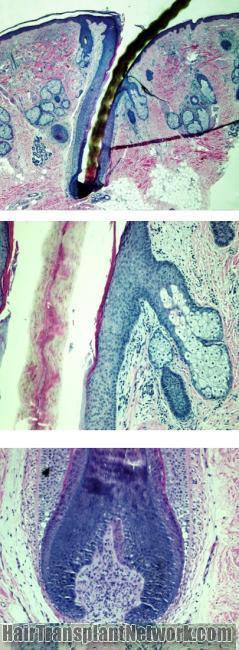
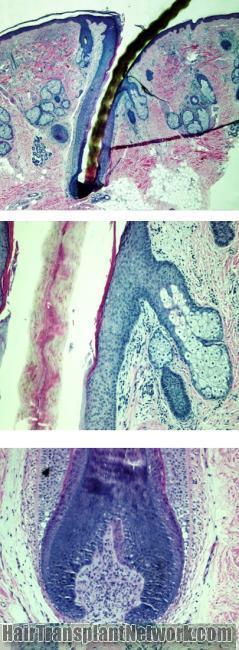
Vellus-like hairs are <0.03 mm in diameter and rarely grow >1-2 mm.
Terminal hairs are coarse >0.06 mm in diameter and can grow up to 3 feet.
A true vellus hair does not have an attached arrector pili muscle.
Only miniaturized vellus-like hairs of androgenetic alopecia have arrector pili muscle.
TRUE or FALSE?
Dr. Rodney Sinclair showed computer-generated 3-D reconstructions of the arrector pili muscle demonstrating that, contrary to classical drawings, a single arrector pili (AP) muscle may serve 2-5 follicles within a follicular unit.
He pointed out that no histological evidence existed of arrector pili musculature in severely miniaturized hairs. He suggested that miniaturized hairs drift away from the AP and that separation from the AP is the point of no return for hair re-growth potential, while in alopecia areata for instance, the muscle maintains its proximity to the hairs possibly explaining its reversibility.
“Loss of attachment between the bulge stem cell population and the arrector pili muscle also explains why miniaturization is irreversible in androgenetic alopecia but not alopecia areata.”
He also suggested there were primary and secondary follicles in the follicular unit with the primary hair follicle the last to drift. Dr. Sinclair also speculated that the APM might be a reservoir for DP cells as well as cytokines and hormones, and may thereby have a role in hair follicle homeostasis. He also raised the possibility that nerve endings in the APM muscle might be involved in the “pain” sometimes associated with hair loss. Alternatively, this pain could be explained by the inflammation Dr. Whiting found to be present in 10% of cases of androgenetic alopecia.
<<<<<<<<<<<<<<<<<<<<<<<<<<<<<<<<
Anyway, sure, e.g. dermal sheath cup cells (DSC) from the Replicel guys (or any other approach) are able to repair all these heavily damaged miniaturized hair follicles, sure - especially if you look at the 2nd pic (on the right) above …
Irreversible damage has already been discussed, particularly with respect to fibrosis of the follicles. There is probably a point at which there is irreversible damage to the follicles, whether due to fibrosis or some other cause as described here. The extent of this would vary from person to person.
However, Replicel’s procedure is thought to work in two ways – rejuvenation of some miniaturized follicles, and de novo induction of brand new follicles. If you watch the CEO’s video, he says this several times.
» Irreversible damage has already been discussed, particularly with respect
» to fibrosis of the follicles. There is probably a point at which there is
» irreversible damage to the follicles, whether due to fibrosis or some other
» cause as described here. The extent of this would vary from person to
» person.
»
» However, Replicel’s procedure is thought to work in two ways –
» rejuvenation of some miniaturized follicles, and de novo induction of
» brand new follicles. If you watch the CEO’s video, he says this
» several times.
the “new hair follicles” is out of the question here.
» the “new hair follicles” is out of the question here.
Histogen appears to create new follicles, from their tissue biopsies which show new follicle formation in places where there was previously no follicle. I’m thinking if Histogen can do it, that shows it is doable, and Replicel can potentially form new follicles as well.
» » the “new hair follicles” is out of the question here.
»
» Histogen appears to create new follicles, from their tissue biopsies which
» show new follicle formation in places where there was previously no
» follicle. I’m thinking if Histogen can do it, that shows it is doable, and
» Replicel can potentially form new follicles as well.
Don’t get me wrong…I don’t want to die bald BUT we can only hope.
» However, Replicel’s procedure is thought to work in two ways –
» rejuvenation of some miniaturized follicles, and de novo induction of
» brand new follicles. If you watch the CEO’s video, he says this
» several times.
No roger_that - neither one thing nor the other, and a nicely marketing video is not science. Is that so difficult to understand?
What the Replicel guys do, since many years real BIG biotech companies like the ARI guys try to accomplish what the Replicel jokers claim – and until today, certainly not satisfactory enough (still far away), even including all essential resources…
… and guess what they always mean with “DERMAL CELLS” within their patents “for rejuvenation” of miniaturized hair follicles. Replicel simply DOESN’T have any “secret soucé”. Everything they have is a small follow-up mouse study in 2000, based on Jahoda’s findings. That’s all. That’s really everything they have, without any doubts.
Single follicular unit transplantation reconstructs arrector pili muscle and nerve connections and restores functional hair follicle piloerection.
The autologous transplantation of hair follicles that have been separated into single follicular units is an accepted treatment for androgenetic alopecia. Recent studies demonstrate that the multiple stem cell populations and surrounding cutaneous tissues coordinately regulate the hair follicle functions and skin homeostasis. Therefore, the critical issues for consideration regarding functional hair restoration therapy are reproduction the correct connectivity and cooperation with host cutaneous tissues, including the arrector pili muscle (APM) and nerve system. We report successful establishment of mouse single follicular transplantation model and autonomous restoration of transplanted hair follicle piloerection in mouse skin. Transplanted hair follicles were responsive to the neurotransmitter acetylcholine and formed proper connections with surrounding host tissues such as APM and nerve fibers, which in turn connect with not only the hair follicle bulge region but also the APM. These results demonstrate that the piloerection ability of transplanted hair follicles can be estimated quantitatively. This study makes a substantial contribution towards the development of transplantation therapy that will facilitate future functional regeneration therapy for skin and skin appendages.
» Single follicular unit transplantation reconstructs arrector pili muscle
» and nerve connections and restores functional hair follicle
» piloerection.
»
» The autologous transplantation of hair follicles that have been separated
» into single follicular units is an accepted treatment for androgenetic
» alopecia. Recent studies demonstrate that the multiple stem cell
» populations and surrounding cutaneous tissues coordinately regulate the
» hair follicle functions and skin homeostasis. Therefore, the critical
» issues for consideration regarding functional hair restoration therapy are
» reproduction the correct connectivity and cooperation with host cutaneous
» tissues, including the arrector pili muscle (APM) and nerve system. We
» report successful establishment of mouse single follicular transplantation
» model and autonomous restoration of transplanted hair follicle piloerection
» in mouse skin. Transplanted hair follicles were responsive to the
» neurotransmitter acetylcholine and formed proper connections with
» surrounding host tissues such as APM and nerve fibers, which in turn
» connect with not only the hair follicle bulge region but also the APM.
» These results demonstrate that the piloerection ability of transplanted
» hair follicles can be estimated quantitatively. This study makes a
» substantial contribution towards the development of transplantation therapy
» that will facilitate future functional regeneration therapy for skin and
» skin appendages.
»
» Single follicular unit transplantation reconstructs arrector pili muscle and nerve connections and restores functional hair follicle piloerection - PubMed
A plucked hair doesn’t have sebaceous glands or the arrector pili muscle attachéd anymore. Seems every missing parts regenerate even from just a plucked hair by itself.
Cooley mentioned: “plucked moustache hair planted in the crown after applying ACell MatriStem biopsy of the hair showed completely normal microscopic anatomy, including sebaceous gland and dermal papilla.”
Anyway, it’s not so unusual that basically healthy hair follicles for transplants have the ability for COMPLETE regeneration, including missing hair follicle tissue parts, sebaceous glands, dermal papilla and finally – also the piloerection ability.
Indeed, interesting paper, because -to my best knowledge- nobody else before reviewed and studied the APM functionality after transplantation of follicles - contrary to miniaturized AGA follicles, because Dr. Rod Sinclair did it …
» » Single follicular unit transplantation reconstructs arrector pili
» muscle
» » and nerve connections and restores functional hair follicle
» » piloerection.
» » Single follicular unit transplantation reconstructs arrector pili muscle and nerve connections and restores functional hair follicle piloerection - PubMed
»
» The following (histological) photo shows a PLUCKED and finally transplanted
» beard hair by Dr. Jerry Cooley (just for example)…
» http://www.regrowhair.com/wp-content/uploads/2010/11/14a3.jpg
»
» A plucked hair doesn’t have sebaceous glands or the arrector pili muscle
» attachéd anymore. Seems every missing parts regenerate even from just a
» plucked hair by itself.
»
» Cooley mentioned: “plucked moustache hair planted in the crown after
» applying ACell MatriStem biopsy of the hair showed completely normal
» microscopic anatomy, including sebaceous gland and dermal papilla.”
»
» Anyway, it’s not so unusual that basically healthy hair follicles
» for transplants have the ability for COMPLETE regeneration, including
» missing hair follicle tissue parts, sebaceous glands, dermal papilla and
» finally – also the piloerection ability.
»
» Indeed, interesting paper, because -to my best knowledge- nobody else
» before reviewed and studied the APM functionality after transplantation of
» follicles - contrary to miniaturized AGA follicles, because Dr. Rod
» Sinclair did it …
So is this saying the arrector pili muscle which is transected during FUE or strip micro grafts regenerates after transplantation ? I know Woods insists the sebaceous gland must be included in the FUE extraction and I assume strip micro grafts preserve the same. But it seems difficult to see how a transected muscle can spontaneously regenerate ?
A lot of HT patients, including FUE patients, have said the transplanted hair feels insensitive in their scalps unlike the native hair. These patients seem to be describing the lack of connection to the AP muscle, etc.
I always took it that this was a standard issue with all HTs, not just a problem that some patients have with some follicles.
» A lot of HT patients, including FUE patients, have said the transplanted
» hair feels insensitive in their scalps unlike the native hair. These
» patients seem to be describing the lack of connection to the AP muscle,
» etc.
»
» I always took it that this was a standard issue with all HTs, not just a
» problem that some patients have with some follicles.
If this is the case, that the arrector pili muscle does not regenerate after transplantation, I don’t understand Sinclair’s quote “loss of attachment between the bulge stem cell population and the arrector pili muscle also explains why minaturisation is irreversible in androgenetic alopecia but not in alopecia areata”. Sounds to me like all transplanted hair should be doomed if this is the case ?
» If this is the case, that the arrector pili muscle does not regenerate
» after transplantation, I don’t understand Sinclair’s quote “loss of
» attachment between the bulge stem cell population and the arrector pili
» muscle also explains why minaturisation is irreversible in androgenetic
» alopecia but not in alopecia areata”. Sounds to me like all transplanted
» hair should be doomed if this is the case ?
A good point. Dr. Sinclair is a professor at my university; perhaps I should track him down and demand clarification haha.
EDIT: Didn’t read gmonasco’s post. Silly me. Disregard this.
» » If this is the case, that the arrector pili muscle does not regenerate
» » after transplantation, I don’t understand Sinclair’s quote “loss of
» » attachment between the bulge stem cell population and the arrector pili
» » muscle also explains why minaturisation is irreversible in androgenetic
» » alopecia but not in alopecia areata”. Sounds to me like all
» transplanted
» » hair should be doomed if this is the case ?
»
» A good point. Dr. Sinclair is a professor at my university; perhaps I
» should track him down and demand clarification haha.
As ALREADY explained in my previous posts in this thread - where is the difference between
HEALTHY and not AGA affected hair follcles for transplants and
AGA affected MINIATURIZED hair follicles??
I wonder what’s so unclear and what for I posted some pics (including Sinclair’s explanations) …
healthy und not AGA affected follcles = healthy and not AGA affected follcles;
AGA affected MINIATURIZED follicles = AGA affected MINIATURIZED follicles
The real SCIENTIFIC paper/study is still in press.
I put all related sinclair-papers/parts concerning this topic in chronological order…
img/uploaded_files/2879_file50.pdf
Anyway, on the last page (page 4), in Jul/Aug 2011, Dr. Sinclair wrote:
“We do have a paper in press on the anatomy of the arrector pili muscle and its relationship with the hair follicle that shows loss of contact of AP muscle with miniaturised hair follicle within a follicular unit.
(Yazdabadi, A., et al. Miniaturized hairs maintain contact with the arrector pili muscle in alopecia areata but not in androgenetic alopecia: A model for reversible miniaturization and potential for hair regrowth).”
Maybe @jimmy is able to get this paper earlier (I doubt that) from Sinclair, because he says Dr. Sinclair is a professor at his university (Australia). I’am keenly awaiting this paper since almost 2 years.
Getting the paper may be a bit of a stretch, but fwiw I wouldn’t mind trying, or at the least asking him any questions you have? I’m not sure how secretive researchers usually are though.
Although I’ll admit, I’m unsure as to why you’re awaiting this paper so keenly - you seem fairly adamant about your opinion irrespective of said paper.
» Getting the paper may be a bit of a stretch, but fwiw I wouldn’t mind
» trying, or at the least asking him any questions you have? I’m not sure how
» secretive researchers usually are though.
Depending on the medical journal or publisher in general, usually it is not allowed to publish any research findings/details/photos/data/numbers etc before the paper/study is published in a medical journal - not even such presentations/informations (pdf-file above) are allowed as Dr. Sinclair did - usually. In other words, you now already KNOW what’s going on …
This is an advertising site for paid
advertisers to showcase successful hair restoration results only. It is not the
mandate of this site to engage in the discussion of failed, unsuccessful
procedures, lawsuits, litigations, refunds or complaint cases. Surgical hair
restoration procedures carry risks. Please do thorough research, consult your
own physician and investigate a doctor's background carefully before making a
decision. By proceeding to use our site, you agree to abide by our Terms of Use & Privacy Policy at http://hairsite.com/terms-of-use/ where you can also find a list of HairSite's sponsoring physicians.