That’s unfortunate. Sorry I couldn’t be of service then.
» The following (histological) photo shows a PLUCKED and finally transplanted
» beard hair by Dr. Jerry Cooley (just for example)…
» http://www.regrowhair.com/wp-content/uploads/2010/11/14a3.jpg
»
» A plucked hair doesn’t have sebaceous glands or the arrector pili muscle
» attachéd anymore. Seems every missing parts regenerate even from just a
» plucked hair by itself.
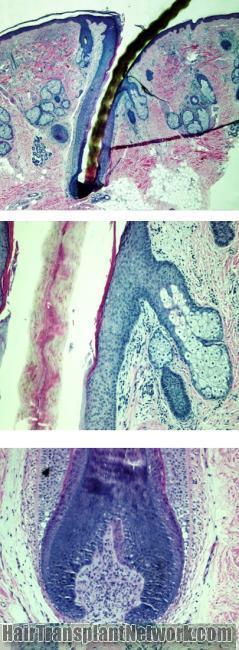
I’m not seeing any AP in that picture, though. I have looked though quite a lot of histology slides of neogenic hair follicles from Follica, RepliCel etc, and never been able to spot a single AP, which is bothersome imo. Of course, it could just be that, being quite thin, it is hard to catch on a slide like that.
What’s interesting is that you often hear remarks as from Cooley saying that the follicle is of completely normal anatomy, including sebaceous gland etc. Yet, no one says anything about the AP, which I think they should had it regenerated, since that would be vastly more impressive considering the difference in cell lineage between HF cells and smooth muscle cells.
» » The following (histological) photo shows a PLUCKED and finally
» transplanted
» » beard hair by Dr. Jerry Cooley (just for example)…
» » http://www.regrowhair.com/wp-content/uploads/2010/11/14a3.jpg
» »
» » A plucked hair doesn’t have sebaceous glands or the arrector pili muscle
» » attachéd anymore. Seems every missing parts regenerate even from just a
» » plucked hair by itself.
»
» I’m not seeing any AP in that picture, though. I have looked though quite a
» lot of histology slides of neogenic hair follicles from Follica, RepliCel
» etc, and never been able to spot a single AP, which is bothersome imo.
That’s the whole point - as Dr. Sinclair mentioned, in the past, NOBODY else really focused his studies towards APM. Cooley, for instance, he completely ignored this part. But it doesn’t mean that his plucked and grafted beard hair indeed has an APM; because during the histological procedure, they simply didn’t focus on the AMP or stained the tissue sample, whereby the APM -according to other papers- is extremely difficult to “extract” or to see (making visible) for the purpose of getting photogaphic evidence for the APM.
» 
» >>>>>>>>>>>>>>>>>>>>>>>>>>>>>>>>>>>>>>
Snippet from my post in another thread…
http://www.hairsite.com/hair-loss/forum_entry-id-98977-page-1-category-1-order-last_answer.html
» >>>>>>>>>>>>>>>>>>>>>>>
» … scientists and researchers discovered that most hair
» follicles in baldness sufferers aren’t dead. Instead, they are only
» dormant. The follicles, it was discovered, are encapsulated in cist-like
» structures that block the normal flow of nutrients. While the entrapment
» continues, a follicle is incapable of producing hair of normal strength and
» diameter. But end the entrapment, and natural hair growth resumes.
»
» This model has been confirmed by the academic scientific community. In
» early 2011, a team of scientists at the University of Pennsylvania
» [Cotsarelis] made headlines when they announced their findings.
» <<<<<<<<<<<<<<<<<<<<<<<<
Seriously, this is basically true…
The (histopathological) pic below shows such an “in cist-like structure encapsulated follicle”.

In fact, the pic shows a small vellus hair follicle which is dwarfed by the adjacent sebaceous gland. It shows what Dr. Cosarelis and his team recently found within the skin samples they got from (bald) hair transplant patients. So it’s not surprising that they still could find any hair stem cells within these samples. But there is a big problem (besides many other/additional problems)…
Stage 1
Everybody knows that when terminal hairs start to convert to vellus hairs (and stay vellus hairs) - you go “bald” - but all these many vellus hairs are still there in your scalp, meaning, you’re actually not “slick bald”, even it looks like that. That’s the earliest change.
Stage 2
In the next phase, after an unkown timeline, these vellus hairs become not a part anymore of the erector pili muscle structure, which holds together healthy terminal hairs producing follicular units (2-4 follicles). But the decrease in size in general of the erector pili muscle(s) is typically somewhat slower than the rate of follicular atrophy. The latter means, that an additional nutrition support is gone for such weak vellus hairs; additionally, because vellus hair follicles and the dermal papillas typically do not contain capillaries anymore! But all these tiny vellus hairs can still survive for a long time, like a (useless) maggot in a bacon. Anyway, this is still the phase/stage where scientists believe that in theory you still could reawake such tiny vellus hairs to thick terminal hairs again.
Stage 3
In the very advanced stage -and this is also known- such (scalp)vellus hairs simply disappear, and leave just a hyaline or sclerotic dermal strand in the skin. The latter is definitely the “point of no return” phase. In other words and to summarize all the above, bald guys have BOTH in their scalps - lots of tiny vellus hairs as well as “Game-Over-Follicles” - mostly both, depending on age, timelines etc.
<<<<<<<<<<<<<<<<<<<<<<<<<<<<<<<<<<<<<<<<<<<
Just for the record…
http://www.baldingblog.com/2012/04/02/do-bald-guys-have-a-full-head-of-hair-that-just-wont-grow/

PLEASE, do not quote such long posts!!
Use the “delete text completely” feature.
» 
» Vellus-like hairs are <0.03 mm in diameter and rarely grow >1-2 mm.
» Terminal hairs are coarse >0.06 mm in diameter and can grow up to 3 feet.
»
» - A true vellus hair does not have an attached arrector pili muscle.
» - Only miniaturized vellus-like hairs of androgenetic alopecia have
» arrector pili muscle.
» TRUE or FALSE?
»
» >>>>>>>>>>>>>>>>>>>>>>>>>>>>>>>>>>>>>>
» Dr.
» Rodney Sinclair showed computer-generated 3-D reconstructions of the
» arrector pili muscle demonstrating that, contrary to classical drawings, a
» single arrector pili (AP) muscle may serve 2-5 follicles within a
» follicular unit.
»
» He pointed out that no histological evidence existed of arrector pili
» musculature in severely miniaturized hairs. He suggested that
» miniaturized hairs drift away from the AP and that separation from the AP
» is the point of no return for hair re-growth
» potential, while in alopecia areata for instance, the muscle maintains
» its proximity to the hairs possibly explaining its reversibility.
» “Loss of attachment between the bulge stem cell population and
» the arrector pili muscle also explains why miniaturization is
» irreversible in androgenetic alopecia but not alopecia
» areata.”
»
» He also suggested there were primary and secondary follicles in the
» follicular unit with the primary hair follicle the last to drift. Dr.
» Sinclair also speculated that the APM might be a reservoir for DP cells as
» well as cytokines and hormones, and may thereby have a role in hair
» follicle homeostasis. He also raised the possibility that nerve endings
» in the APM muscle might be involved in the “pain” sometimes associated with
» hair loss. Alternatively, this pain could be explained by the
» inflammation Dr. Whiting found to be present in 10% of cases of
» androgenetic alopecia.
» <<<<<<<<<<<<<<<<<<<<<<<<<<<<<<<<
»
» Anyway, sure, e.g. dermal sheath cup cells (DSC) from the Replicel guys (or
» any other approach) are able to repair all these heavily damaged
» miniaturized hair follicles, sure - especially if you look at the 2nd pic
» (on the right) above …
If true, how long before vellus hair can no longer be made into a terminal hair?
I suspect it could take many decades.
For example, as we become adults we start to grow more and more body hair (I was still sprouting new body hair into my early thirties).
Did such body hair exist as vellus hair thoughout our early years, and then become terminal as we aged?
How about beard hair? Might beard hair have existed for one or two decades before being converted to terminal hair?
How about women who grow mustaches and sideburns in their late twenties and thirties? Might that hair have first existed as vellus hair for decades?
In my own experience, I’ve had parts of my scalp that had been bald for ten years regrow hair when I took a DHT blocker.
Most astounding of all was a single hair that regrew at the front of my scalp, from a follicle that had not grown hair for twenty or more years. (This follicle has continued to grow hair for the past ten+ years, ever since I started DHT blockers. This follicle as cycled once in that ten+ year period).
So it may take decades for a follicle that stops growing terminal hair, to be incapable of ever growing terminal hair again.
It might also be possible to extend the time it takes for a vellus hair to reach the point of no return by taking Rogaine and/or a DHT blocker.
» It might also be possible to extend the time it takes for a vellus hair to
» reach the point of no return by taking Rogaine and/or a DHT blocker.
In this case, explain me that…
by a guy, today: just a rant.
It seems to me that many around here believe that hair loss is treatable or at least it can be slowed down to some extent. Well not in my case! So here’s my story. I started the process when I was around 19- 20 years old. I immediately visited a dermatologist who gave me Finasteride and Minoxidil. Even though I’ve used them religiously for the past 4 years I am now norwood 6.
Throughout these years I have tried all sort of stuff, increasing Finasteride, using Dutasteride, using Nizoral and shamefully used a number of other gimmicky products. Fin never gave me side effects, everything still works A ok. But my hair loss never showed signs of stopping. So why not get a hair transplant ? Well it seems that these are only available to those who are at least 30 and only have moderate balding. Unfortunately I am young, have average donor and density and a large area to fill, so I do not qualify. Therefore I have now exhausted all my treatment options to no avail.
To wrap it all up, I think there are many other youngsters who like me experience such aggressive balding that they can’t halt it in any way. So yes, some of us can’t do anything about it! For all those who are thinking of starting treatment please don’t be discouraged, from what it seems this might be able to buy you a couple of years (I still believe it is worth a try, and wish it worked).
Sorry for sounding a bit bitter, but I felt I needed to blurt this out!
Finasteride, Minoxidil and Nizoral. I am only using originator products. When I look at my own pictures, I find it hard to believe how quickly it occurred. To be completely honest I tried Dut only for 4 months. However I don’t think I am the only one. Most of my cousins where slick bald by 30, my father still enjoys a relatively full head of hair.
<<<<<<<<<<<<<<<<<<<<<<<<<<<<<<<<<<<<<<<<<
Ah, I know - the guy was “not a good responder” … 
Once one or more “gene clocks” start to act - THAT is in my opinion the “point of no return”. You CAN’T do anything against that. It’s the same as with the AGING gene clocks - you can’t life forever.
Damn poor fuker.That’s very depressing. Must have had a tough life.
But everything points out youre right unfortunately.
I think we should all join slybaldguys.com and get this sh1t over with.
» Damn poor fuker.That’s very depressing. Must have had a tough life.
»
»
» But everything points out youre right unfortunately.
»
»
»
»
» I think we should all join slybaldguys.com and get this sh1t over with.
Everything points out he’s right? lol There are contradicting studies. Not to mention as another member just pointed out he had a follicle start producing hair that hadn’t for over ten years as I am sure many other people have also. To be honest, no one REALLY knows for sure.
»
» In my own experience, I’ve had parts of my scalp that had been bald for ten
» years regrow hair when I took a DHT blocker.
»
» Most astounding of all was a single hair that regrew at the front of my
» scalp, from a follicle that had not grown hair for twenty or more years.
» (This follicle has continued to grow hair for the past ten+ years, ever
» since I started DHT blockers. This follicle as cycled once in that ten+
» year period).
when i took a “sc_am” dht blocker 3/4 years ago, i grew a spontaneous, single terminal hair below my right temple/hairline, in the middle of my forehead! and the hair is still here to this day[/[/i]i]…i STOPPED taking dht blockers a long time ago!
I am a firm believer vellus hairs can be restored!
»
» I am a firm believer vellus hairs can be restored!
As am I,
This thread is verging on being ridiculous, there are many things that go wrong when we start to bald, like a domino effect, ultimately you don’t know what the response of the follicles will be when they get the signal to start producing again, it’s just finding the trigger for that signal that is the hard part, but when that trigger is hit and the signal is sent to the follicle and surrounding structure, it could start functioning normally again.
There’s is no end point in science, every disease is curable, it’s just a matter of time and research.
» »
» » I am a firm believer vellus hairs can be restored!
»
» As am I,
»
» This thread is verging on being ridiculous, there are many things that go
» wrong when we start to bald, like a domino effect, ultimately you don’t
» know what the response of the follicles will be when they get the signal to
» start producing again, it’s just finding the trigger for that signal that
» is the hard part, but when that trigger is hit and the signal is sent to
» the follicle and surrounding structure, it could start functioning normally
» again.
»
» There’s is no end point in science, every disease is curable, it’s just a
» matter of time and research.
thats my theory too, unfortunately I base that on absolutely nothing.
Let’s hope we can all get our 18 year old hairline back !!! Even Ironman :).
~22 days remaining for the promise land???

Indeed, it is a question of time and research - time being a highly critical factor to most. Little use for a cure when we’re all geriatric! But ah, I’m just parroting a common complaint. Let’s all place our trust in the logarithmic progression of research to ensure we get something in a timely fashion, huh?
And I’m eighteen; rest assured, I don’t (nor would anyone) want my hairline 
» another member just pointed out he had a follicle start
» producing hair that hadn’t for over ten years as I am sure many other
» people have also. To be honest, no one REALLY knows for sure.
That was me.
But the most amazing thing is that single follicle that stopped growing terminal hair for at least 20 years, then started growing terminal hair after I started a DHT blocker, and has continued to grow hair for the past ten+ years since. This follicle is close to my original hairline so it’s been easy for me to monitor.
Makes me crazy–it’s like what does that follicle have that others don’t???
There was another follicle nearby that did the same thing–but after a year or so that other follicle stopped again and has been out of action since.
Curiosly, both those follicles and a couple of others were for many years the last suvivors of my teenage hailine, until they finally gave out in the early 1980s.
I’m a case in which minoxidil works really good. In fact I’m one of the best responders to minoxidil. But it doesn’t grow me all the hairs back so I also believe that that for some follicles there’s no return. But unfortunately I have to quit minoxidil because I can’t tolerate the alcohol in minoxidil. I wish there was a alcohol free version of it. Also I noticed when I was on minoxidil my scalp was not oily but after stopping it my scalp became oily again. Also I was propecia for years but it didn’t do anything for me and I was seeing the side effects.
» » another member just pointed out he had a follicle start
» » producing hair that hadn’t for over ten years as I am sure many other
» » people have also. To be honest, no one REALLY knows for sure.
»
» That was me.
»
» But the most amazing thing is that single follicle that stopped growing
» terminal hair for at least 20 years, then started growing terminal hair
» after I started a DHT blocker, and has continued to grow hair for the past
» ten+ years since. This follicle is close to my original hairline so it’s
» been easy for me to monitor.
»
» Makes me crazy–it’s like what does that follicle have that others
» don’t??? [Because this follicle is “FEMALE-PROGRAMMED”!]
»
» There was another follicle nearby that did the same thing–but after a year
» or so that other follicle stopped again and has been out of action since.
»
» Curiosly, both those follicles and a couple of others were for many years
» the last suvivors of my teenage hailine, until they finally gave out in the
» early 1980s.
Believe it or not - there is no “curio” involved. According ALL your descriptions in lots of other threads - you have definitely “a combination” with female pattern hair loss (FPHL). Females don’t lose all hairs in their hairline (but behind).
Why don’t you read all the papers I posted in this thread??
Within these papers (Dr. Sinclair), they describe this problem explicitely!
» There’s is no end point in science, every disease is curable, it’s just a
» matter of time and research.
Sure, one day they will be even able to cure AGING:
But even though, IF you are able to stop the clock of the ageing genes, that will not bring a baldy his hair back, because you’ll “just” always STAY (or prolong) the same age.
bump!
» bump!
bump!
» » bump!
»
» http://www.hairsite.com/hair-loss/board_entry-id-104164-page-0-category-10-order-last_answer-descasc-DESC.html
»
» bump!
Don’t worry IronMan. Hairsite users do not even need to look at your profile for them to know who’s the real IronMan. If it’s some retarded stupid sh1t comment it’s 2020, if it’s a good intelligent observation it’s gotta be real IronMan.
» stupid sh1t comment it’s 2020, if it’s a good intelligent observation it’s
» gotta be real IronMan.
lol you are such a homo