Patient Overview
-
Patient Name: Satish Ghinaiya
-
Gender: Male
-
Age Group: Early to Mid-30s
-
Hair Loss Condition: Frontal Hairline Recession & Male Pattern Baldness
-
Procedure Performed: DHT Hair Transplant
-
Total Grafts Implanted: 2200 Grafts
-
Result Timeline: 10 Months After Hair Transplan
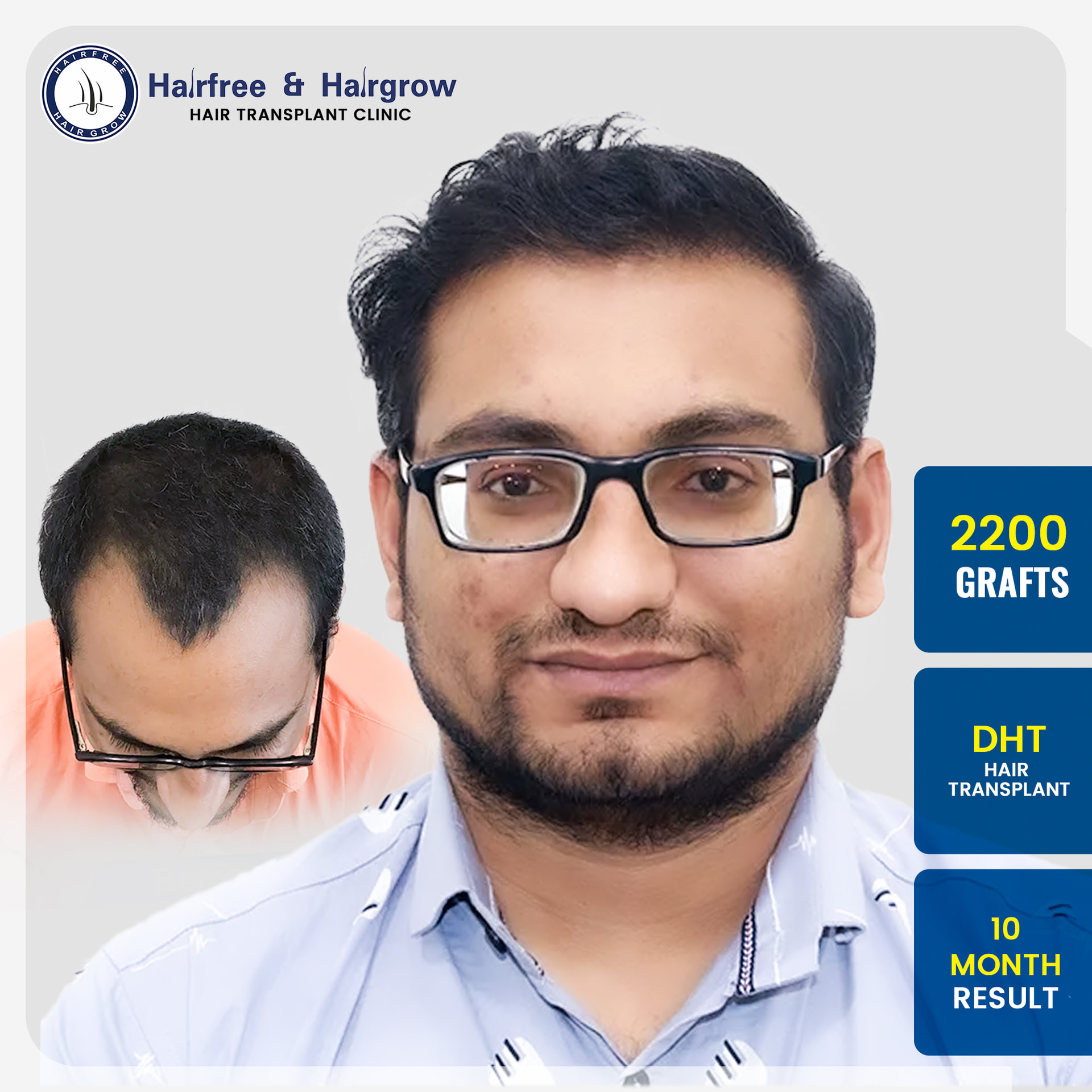
This successful hair transplant transformation showcases the results achieved 10 months after a 2200-graft DHT hair transplant. The procedure focused on restoring the receding frontal hairline, improving density in the frontal scalp, and creating a natural-looking appearance that complements the patient’s facial features.
Before Hair Transplant
Before the procedure, the patient was experiencing noticeable frontal hairline recession with thinning in the front scalp area. The loss of density affected facial framing and made the forehead appear larger.
Primary Hair Loss Concerns
-
Receding frontal hairline
-
Reduced frontal scalp density
-
Visible thinning in the hairline zone
-
Enlarged forehead appearance
-
Loss of youthful facial framing
-
Early to moderate male pattern baldness
-
Difficulty styling hair naturally
-
Reduced confidence due to hair loss
Hair Transplant Planning & Strategy
A personalized treatment plan was designed to restore the frontal appearance while ensuring natural density and long-term aesthetic balance.
Treatment Objectives
-
Reconstruct a natural hairline
-
Increase density in the frontal zone
-
Improve facial proportions
-
Restore youthful appearance
-
Ensure natural hair direction and angulation
-
Achieve seamless blending with native hair
-
Deliver long-lasting and natural-looking results
The treatment primarily focused on the frontal hairline, which has the greatest impact on overall appearance.
Customized Hairline Design
The new hairline was carefully designed after evaluating:
-
Facial structure and proportions
-
Existing native hair characteristics
-
Hair loss pattern
-
Future progression of hair loss
-
Patient’s age and aesthetic goals
-
Natural temple positioning
Hairline Design Goals
-
Natural-looking frontal restoration
-
Soft and irregular hairline pattern
-
Improved facial symmetry
-
Age-appropriate appearance
-
Natural density distribution
-
Seamless blending with existing hair
Advanced DHT Hair Transplant Technique
The procedure was performed using the advanced DHT (Direct Hair Transplant) technique.
DHT allows for the direct implantation of grafts into recipient areas using specialized implantation tools, helping maintain graft quality while achieving precise placement and natural growth patterns.
Benefits of DHT Hair Transplant
-
No linear scar
-
Minimal handling of grafts
-
Faster healing process
-
Natural hair growth pattern
-
High graft survival rate
-
Precise implantation
-
Natural hair direction and angulation
-
Long-lasting results
Strategic Implantation – 2200 Grafts
A total of 2200 grafts were strategically implanted to rebuild the frontal hairline and improve density.
Implantation Focus Areas
-
Frontal hairline reconstruction
-
Frontal scalp density enhancement
-
Temple refinement
-
Natural blending with existing hair
Implantation Highlights
-
Single-hair grafts used at the hairline
-
Strategic density placement
-
Uniform graft distribution
-
Natural angulation and direction control
-
Optimized graft survival
-
Natural-looking density transition
10-Month Hair Transplant Result
At 10 months after the procedure, the patient achieved significant hair growth with excellent density improvement and a naturally restored hairline.
Before Hair Transplant
-
Noticeable frontal hairline recession
-
Reduced density in the frontal scalp
-
Visible thinning
-
Poor facial framing
-
Older appearance due to hair loss
After 10 Months
-
Restored natural hairline
-
Improved frontal density
-
Better scalp coverage
-
Fuller and healthier appearance
-
Enhanced facial framing
-
Natural hair growth pattern
-
Improved confidence and personality
The final result demonstrates excellent graft survival and natural density, creating a hairline that blends seamlessly with the patient’s existing hair.
Hair Growth Journey
0–3 Months
Normal shedding phase as transplanted follicles enter a temporary resting stage.
3–6 Months
New hair growth begins, and early improvements become visible.
6–8 Months
Density increases significantly, and the hairline becomes more defined.
8–10 Months
Continued maturation and thickening of transplanted hair.
Current Stage – 10 Months
-
Strong hair growth
-
Excellent frontal density improvement
-
Natural hairline appearance
-
Significant cosmetic enhancement
-
Stable and promising long-term outcome
Final Outcome
After 10 months, the patient successfully achieved the following:
-
Natural hairline restoration
-
Improved frontal density
-
Better scalp coverage
-
Enhanced facial aesthetics
-
More hairstyle options
-
Natural-looking results
-
Increased confidence
Why This Hair Transplant Case Stands Out
-
2200 grafts strategically implanted
-
Excellent 10-month transformation
-
Natural hairline reconstruction
-
Dense frontal restoration
-
High graft survival rate
-
Natural hair direction and angulation
-
Seamless blending with native hair
-
Long-lasting aesthetic outcome
Conclusion
This 2200-graft DHT hair transplant case demonstrates how strategic planning, advanced implantation techniques, and expert execution can successfully restore a receding hairline and improve overall hair density.
At 10 months post-procedure, Satish Ghinaiya achieved a naturally restored hairline, improved frontal density, and enhanced facial appearance. The transformation highlights the effectiveness of DHT hair transplant technology in delivering natural, dense, and long-lasting results for patients experiencing male pattern baldness.