Patient Profile
-
Patient Name: Sanket Malvankar
-
Gender: Male
-
Age Group: Adult Male
-
Procedure: I-FUE Hair Transplant
-
Total Grafts: 5,000 Grafts
-
Result Timeline: 8 Months After Procedure
-
Location: Pune, Maharashtra, India
-
Primary Concern: Significant hair loss and reduced scalp coverage
-
Treatment Goal: Improve hair coverage, density, frontal appearance, and overall hair restoration
Patients researching the best hair transplant in Pune should understand that graft requirements and treatment planning vary according to the individual’s hair-loss pattern, donor-area availability, recipient-area requirements, hair characteristics, and long-term restoration goals.
Patient Overview
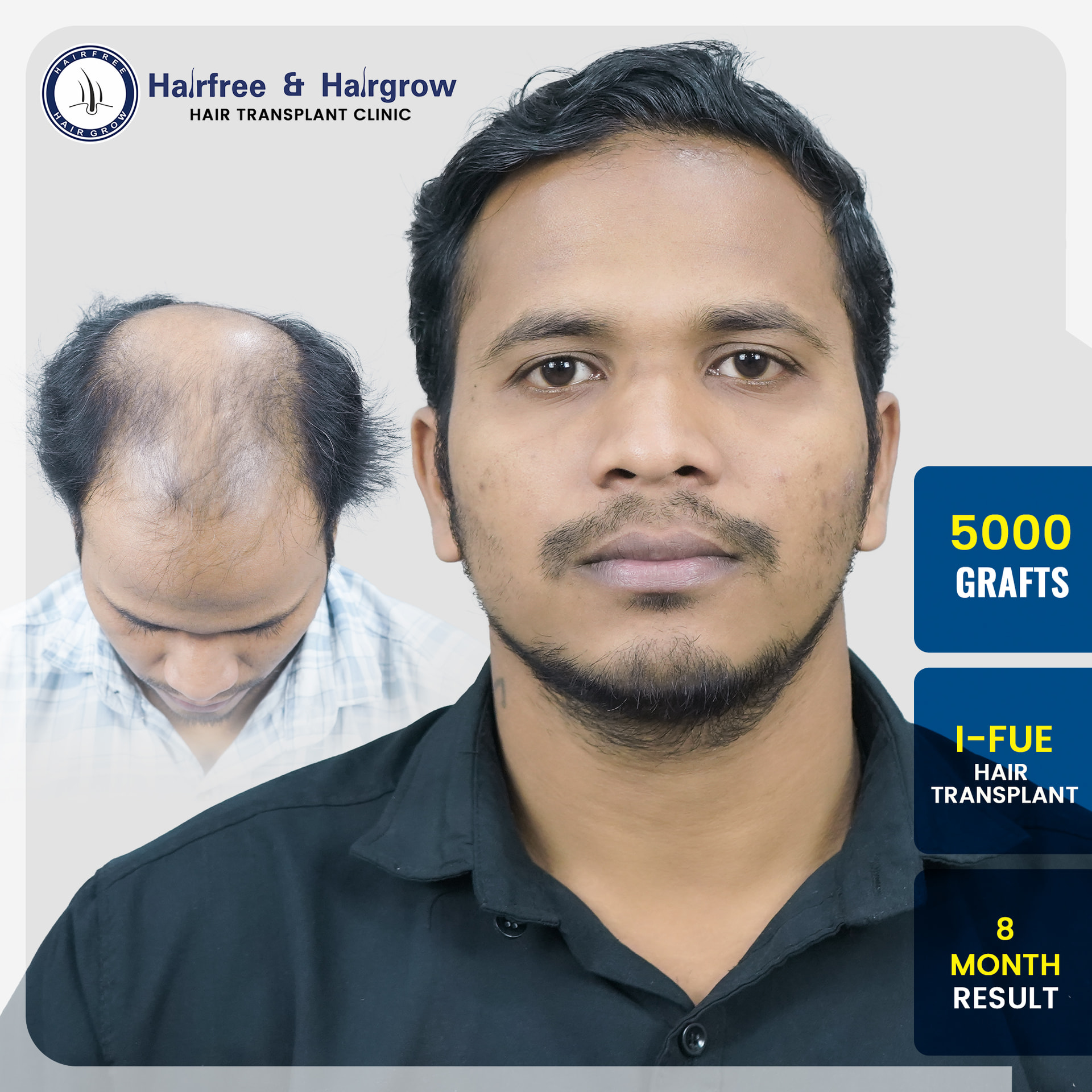
Sanket Malvankar underwent a 5,000-graft I-FUE hair transplant to address significant hair loss and improve overall scalp coverage.
The before-and-after photographs show a noticeable difference in hair coverage between the pre-treatment and 8-month follow-up images. The restored hair contributes to improved frontal and overall scalp coverage and a fuller-looking appearance.
As with every hair transplant, the treatment approach should be customized according to the patient’s individual hair-loss pattern and available donor hair.
Hair Loss Concerns
Before the procedure, the patient had noticeable hair loss with significant scalp visibility and reduced overall hair coverage.
The main treatment objectives included:
-
Improving visible scalp coverage
-
Restoring areas affected by hair loss
-
Increasing the appearance of hair density
-
Improving frontal hair coverage
-
Creating a fuller-looking overall appearance
-
Maintaining a natural transition between transplanted and existing hair
Donor and Recipient Area Planning
Hair transplantation requires careful planning of both the donor and recipient areas. The available donor hair needs to be distributed strategically according to the areas requiring restoration.
For Sanket’s treatment, planning focused on:
-
Available donor grafts
-
Extent of hair loss
-
Recipient-area requirements
-
Existing native hair
-
Desired coverage
-
Natural hair-growth direction
-
Graft distribution
-
Long-term hair restoration planning
The objective was to utilize the available 5,000 grafts strategically to improve coverage across the areas affected by hair loss.
5,000-Graft I-FUE Hair Transplant in Pune
Sanket underwent a 5,000-graft I-FUE hair transplant in Pune.
I-FUE involves the extraction of individual follicular units from the donor area followed by implantation into planned recipient areas. Graft placement can be customized according to the recipient area’s requirements, natural hair direction, existing hair, and desired aesthetic appearance.
Treatment Highlights
-
5,000 grafts implanted
-
I-FUE hair transplant technique
-
Individual follicular-unit extraction
-
Strategic graft placement
-
Focus on improving scalp coverage
-
Attention to natural hair direction
-
Improvement in apparent hair density
-
Long-term donor-area considerations
8-Month Hair Transplant Result
At approximately 8 months after the I-FUE hair transplant, the before-and-after photographs demonstrate visible improvement in hair coverage and overall appearance.
The post-treatment photograph shows substantially greater hair coverage compared with the pre-treatment image, with reduced scalp visibility and a fuller-looking appearance.
Visible Improvements
-
Improved overall scalp coverage
-
Greater apparent hair density
-
Reduced scalp visibility
-
Fuller-looking hair
-
Improved frontal appearance
-
More balanced overall hair coverage
An 8-month result represents an important stage of hair growth, although hair characteristics and maturation can continue to change over time. Individual results vary between patients.
Why Is Graft Planning Important?
The number of grafts required for a hair transplant is different for every patient. Factors that may influence graft requirements include:
-
Extent of hair loss
-
Size of the recipient area
-
Donor-hair availability
-
Donor density
-
Hair thickness
-
Follicular-unit characteristics
-
Existing native hair
-
Desired coverage
-
Future hair-loss progression
-
Long-term donor preservation
In Sanket’s case, 5,000 grafts were used as part of his individual hair-restoration plan.
What Is I-FUE Hair Transplant?
I-FUE (Implanter Follicular Unit Extraction) is a hair-transplant approach in which follicular units are extracted from the donor area and implanted into planned recipient areas.
The final appearance depends on multiple factors, including donor-hair quality, graft selection, hairline design, graft distribution, implantation direction, recipient-area characteristics, and post-operative care.
Therefore, patients should evaluate the overall treatment plan and suitability assessment rather than choosing a clinic based only on graft numbers or treatment cost.
Final Outcome
Sanket Malvankar’s 5,000-graft I-FUE hair transplant in Pune shows visible improvement at the 8-month follow-up.
The before-and-after photographs demonstrate improved hair coverage, reduced scalp visibility, increased apparent density, and a fuller overall hair appearance.
This case highlights the importance of:
-
Individualized hair-loss assessment
-
Donor-area evaluation
-
Appropriate graft planning
-
Natural hairline and coverage planning
-
Strategic graft distribution
-
Proper implantation direction
-
Long-term hair restoration planning
-
Appropriate post-operative care