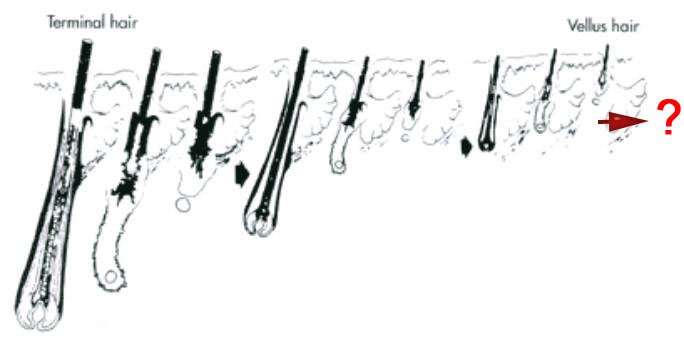
Is there a picture of a skin sample of a balding follicles under a microscope vs a normal hair follicles?
I’ve seen it somewhere but I can’t find it.
Meanwhile here’s an interesting PDF from a Japanese company doing research on balding that I posted earlier. It shows that balding is due to reduction in the hair shaft diameter more so than reduction in the number of hairs.
I was thinking about something similar a while ago when people were asking about getting a realistic hairline. Surely there must be a way of telling under a microscope which follicles have become miniaturized so a company like Histogen can map the area with precision if their treatment works, the same will apply to Follica as well.
I’m trying to not get ahead of myself but it does make you think how will they get a hairline right with these treatments, I’m sure the majority of people would prefer to have their hairline where it was before MPB set in?
» Meanwhile here’s an interesting PDF from a Japanese company doing research
» on balding that I posted earlier. It shows that balding is due to
» reduction in the hair shaft diameter more so than reduction in the number
» of hairs.
You’re still hung up on that :S You’ve been told several time (even my own personal observation) that in bald men the hair only minitaurize…I can see fine hair all over my scalp(NW0 hairline) and I’m NW7. Cotsarelis’ recent study and several other studies have also confirmed this, yet you keep bringing up this point over and over???
IMHO building a realistic hairline is one of the most over-worried issues in the entire subject of HM. It’s not that difficult. If the treatments can’t be tailored that specifically, then they can just grow hair farther down than the hairline and then use conventional hair-removal techniques to fade it realistically.
If that doesn’t work, then even conventional HTs can produce great hairlines with enough donor hair and FUE work from the back of the neck.
When all the hair behind the first centimeter is full density then nobody is gonna be scrutinizing the hairlines anyway. If you compared a guy with a natural head of hair but with a mediocre HT hairline in front, next to a guy with a totally natural hairline but the rest of his head has only thin HT coverage . . . I guarantee you it would be the latter guy’s (natural) hairline that people will think is more phony.
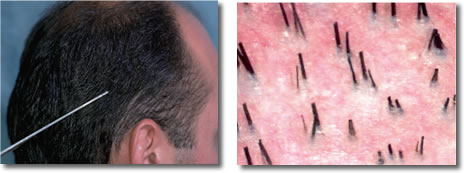
In the patient below, we see a close-up of the side of his scalp where the hair is not affected by DHT. We see mostly groups of full thickness hairs (called terminal hairs) and a few scattered fine, vellus hairs. This is normal.
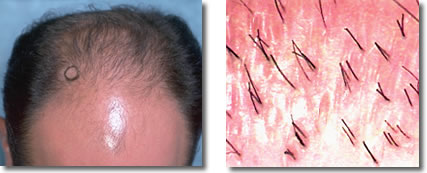
In the area of thinning (see circle below), we see that most of the hair has been miniaturized, although all of the hair is still present.
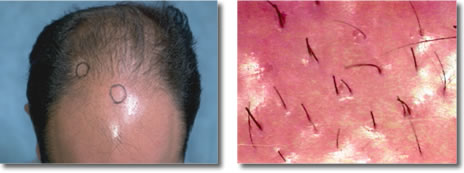
In the region that is balding (second circle in the center), there is extensive miniaturization and some, but not all of the hair has disappeared.
What this shows is that the initial appearance of balding is due to the progressive decrease in hair shaft size, rather than the actual loss of hair – in early hair loss, all the hair is still present. This is the reason why hair loss medications, such as finasteride (Propecia) work in early hair loss (since they are able to partly reverse the miniaturization process) but don’t work in areas that are totally bald. It is also the reason why men’s hair restoration surgery, if not planned properly, can result in hair loss due to the shedding of surrounding miniaturized hair.
» You’re still hung up on that :S You’ve been told several time (even my own
» personal observation) that in bald men the hair only minitaurize
I guess there is a difference between bald and balding.
The question of whether hair follicles are still alive in bald (NW7) person is an important one.
Look at the pictures posted by Khalil. It seems to suggest that not only do hairs miniturize, the next stage after that (if MPB is left untreated) is that hairs begin to disappear!! (die?) off. We can only pray that they go into telogen (resting phase) rather than dying off altogether. If its the latter, even treatments like Histogen may not help those who are very bald.
Although histogen claims that they believe (not sure) that their treatment results in the genesis of new hair follicles so maybe there is still hope even for the terminally bald.
BTW to answer your question, Histogen mentioned specifically in their interview on the Bald Truth radio show that the effect of their stuff is localized. This is great as they can inject very small quantities in areas around the scalp and have the hairs grow there. I think ultimately they could make it such that 1 injection with a tiny amount of their liquid generates 1 follicle. That way you’d get 10,000 injections per treatment, come back the next week, another 10,000…etc until you are satisfied.
Its really the least of our worries in my opinion. The main thing is that their stuff should be able to grow hair on demand and that’s the biggest challenge. The rest is just gravy. Hair transplant surgeons can then work on giving us the perfect hair line to frame our face. FUE has already been perfected.
» IMHO building a realistic hairline is one of the most over-worried issues
» in the entire subject of HM.
It will surely be the least of our worries. The main thing is that they are able to generate hair.
Whether they do it on our heads or our ass is of little consequence because as you point out, everything can be shifted and shuffled around.
BTW this also explains a question I had raised earlier :
Why does Aderans mention that their technology of injecting new hair follicle cells will be used together with a hair transplant?
I could not figure that out. If they say they can generate new hair follicles with an injection, why the need for a hair transplant? But thinking about it now, it would seem that they are not able to control the orientation of the injected hairs. Thus to ‘blend’ it in so it looks proper, they use traditional transplants to create a ‘frame/skeleton’ where direction of hair can be controlled. This gives a more aesthetic appearance even if the injected hairs are not oriented perfectly.
Hell all us guys are asking for is something that looks like hair, it need not be perfectly aligned as mother nature intended.
» Hair Loss Causes Reasons for Balding | Bernstein Medical
»
» In the patient below, we see a close-up of the side of his scalp where the
» hair is not affected by DHT. We see mostly groups of full thickness hairs
» (called terminal hairs) and a few scattered fine, vellus hairs. This is
» normal.
»
»
»
» In the area of thinning (see circle below), we see that most of the hair
» has been miniaturized, although all of the hair is still present.
»
»
»
» In the region that is balding (second circle in the center), there is
» extensive miniaturization and some, but not all of the hair has
» disappeared.
»
»
»
» What this shows is that the initial appearance of balding is due to the
» progressive decrease in hair shaft size, rather than the actual loss of
» hair – in early hair loss, all the hair is still present. This is the
» reason why hair loss medications, such as finasteride (Propecia) work in
» early hair loss (since they are able to partly reverse the miniaturization
» process) but don’t work in areas that are totally bald. It is also the
» reason why men’s hair restoration surgery, if not planned properly, can
» result in hair loss due to the shedding of surrounding miniaturized hair.
I’m a little bit shocked by this to be honest. Please don’t insult me or anything but I’m diffusely thinning and if I look closely enough at thinning areas I can see areas of skin where I don’t see a hair but in contrast on the sides and back it’s totally covered with hairs. Wouldn’t the space where you see skin between thinning hairs as seen on the man on Dr. Bernstein’s website imply that there is no hair present. Even miniturized hairs can be seen if you look closely but if there is a patch of skin then it would appear to the human eye as if you don’t have all the hair present, don’t get me wrong I’m very happy to see this because it means I probably have most of my hair being a diffuse thinner I just want to understand.
» » Hair Loss Causes Reasons for Balding | Bernstein Medical
» »
» » In the patient below, we see a close-up of the side of his scalp where
» the
» » hair is not affected by DHT. We see mostly groups of full thickness
» hairs
» » (called terminal hairs) and a few scattered fine, vellus hairs. This is
» » normal.
» »
» »
»
» »
» » In the area of thinning (see circle below), we see that most of the hair
» » has been miniaturized, although all of the hair is still present.
» »
» »
»
» »
» » In the region that is balding (second circle in the center), there is
» » extensive miniaturization and some, but not all of the hair has
» » disappeared.
» »
» »
»
» »
» » What this shows is that the initial appearance of balding is due to the
» » progressive decrease in hair shaft size, rather than the actual loss of
» » hair – in early hair loss, all the hair is still present. This is the
» » reason why hair loss medications, such as finasteride (Propecia) work in
» » early hair loss (since they are able to partly reverse the
» miniaturization
» » process) but don’t work in areas that are totally bald. It is also the
» » reason why men’s hair restoration surgery, if not planned properly, can
» » result in hair loss due to the shedding of surrounding miniaturized
» hair.
Also, now that we know hair loss is likely related to a lack of progenitor cells, do doctors or chemists not know of a way to extract some active progenitor cells and multiply them in vitro and then re-inject them into the human scalp? I know, I’m very late on this, try to be respectful if possible.
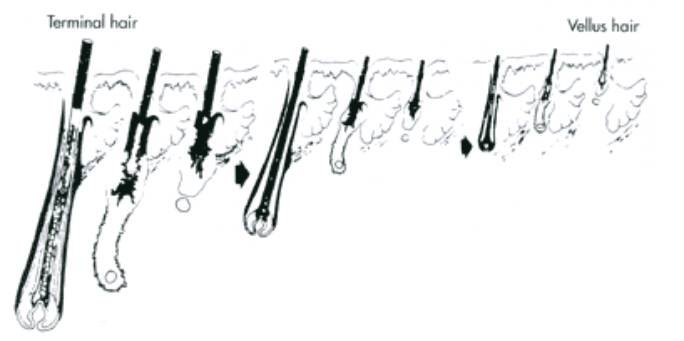
» » The graphic above slightly improved …
» »
»
» With regards to your question mark, Cotsarelis says the hair follicle will
» always be there.
No, that is CLEARLY not what they (recently) found out/investigated. What they found could produce practically everything - e.g. nerves, skin, blood vessels and -sure- hair follicles too. Actually, even a whole new you.
» » » The graphic above slightly improved …
» » »
» »
» » With regards to your question mark, Cotsarelis says the
» hair follicle will
» » always be there.
»
» No, that is CLEARLY not what they (recently) found out/investigated. What
» they found could produce practically everything - e.g. nerves, skin, blood
» vessels and -sure- hair follicles too. Actually, even a whole new you.
» Wouldn’t
» the space where you see skin between thinning hairs as seen on the man on
» Dr. Bernstein’s website imply that there is no hair present. Even
» miniturized hairs can be seen if you look closely but if there is a patch
» of skin then it would appear to the human eye as if you don’t have all the
» hair present,
from what i understand velus hairs cover our entire body. this is a vestige of our ansestors who had fur all over like modern apes do today. the difference between hair we had on our head and the body velus hair is thickness & rate of growth.
its not a stretch of the imagination to realise how modern humans lost most of their body fur - the same mechanism as MPB i would wager.
This is an advertising site for paid
advertisers to showcase successful hair restoration results only. It is not the
mandate of this site to engage in the discussion of failed, unsuccessful
procedures, lawsuits, litigations, refunds or complaint cases. Surgical hair
restoration procedures carry risks. Please do thorough research, consult your
own physician and investigate a doctor's background carefully before making a
decision. By proceeding to use our site, you agree to abide by our Terms of Use & Privacy Policy at http://hairsite.com/terms-of-use/ where you can also find a list of HairSite's sponsoring physicians.