Case Overview
-
Patient: Anonymized adult male
-
Procedure: I-FUE hair transplant
-
Documented graft count: 4,000
-
Follow-up period: Approximately 11 months
-
Clinic: Hairfree & Hairgrow Hair Transplant Clinic
-
Location: Pune, Maharashtra, India
Clinical Background
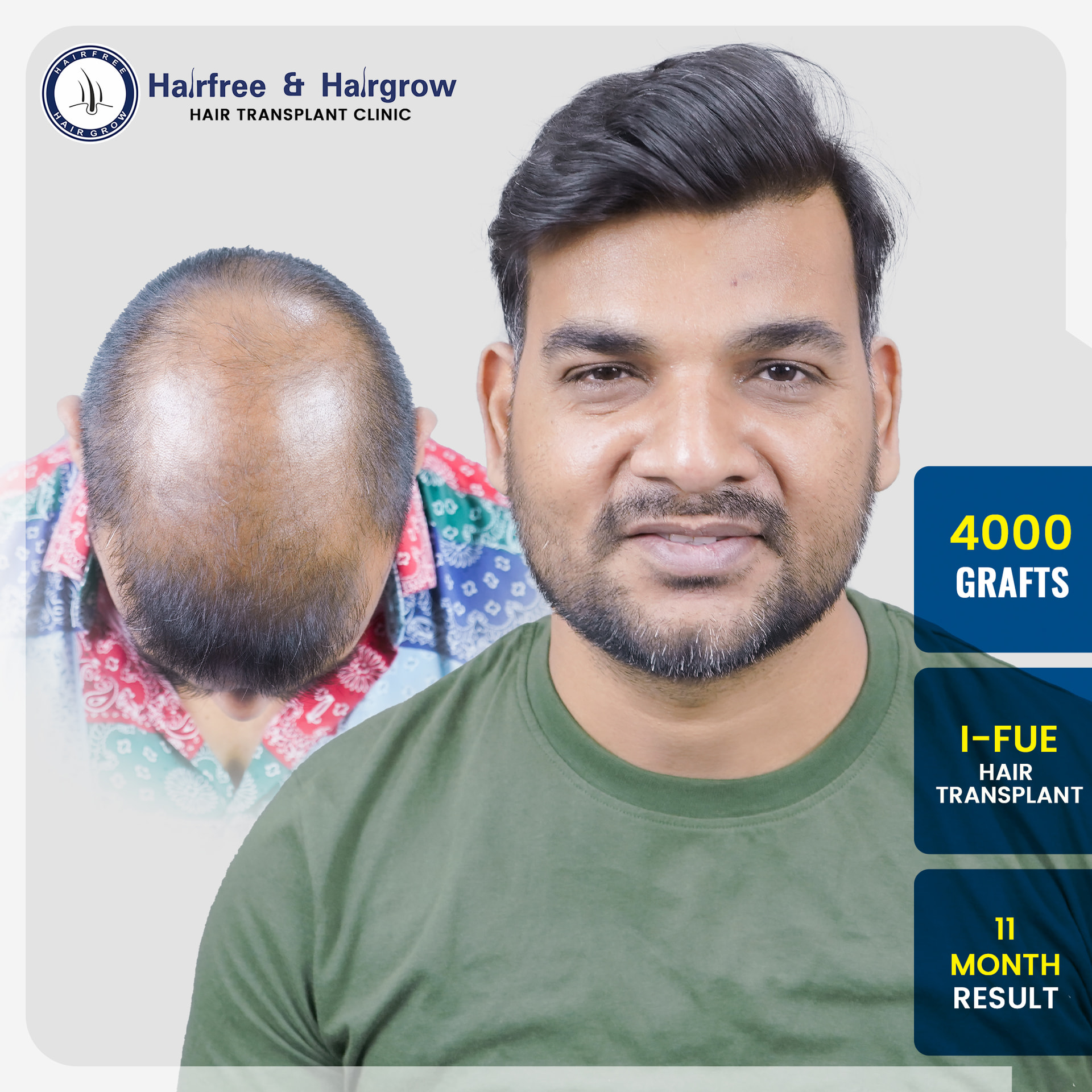
This educational case documents the follow-up of an adult male who underwent an I-FUE hair transplant involving 4,000 grafts at Hairfree & Hairgrow Hair Transplant Clinic in Pune, Maharashtra.
The available clinical image presents a pre-treatment view of the scalp alongside a photograph taken approximately 11 months after the procedure. The photographs can be used to discuss the importance of documenting hair restoration over time, subject to appropriate patient anonymization, consent, and applicable professional guidelines.
A complete clinical record should document the patient’s initial hair-loss pattern, donor-area assessment, treatment plan, postoperative course, and follow-up findings.
Understanding the 11-Month Follow-Up
Hair transplantation involves moving suitable follicular units from a donor area to selected areas of the scalp. Hair growth develops progressively after surgery, and the appearance at an individual follow-up appointment should be interpreted in the context of the patient’s clinical history.
An 11-month photograph provides a record of the scalp’s appearance at that particular stage. It does not independently establish graft survival, final hair density, long-term stability, or the absence of complications.
For meaningful clinical documentation, photographs should be captured using consistent lighting, camera angles, hair length, and positioning. Clinical observations should be recorded separately from visual impressions.
What Is I-FUE Hair Transplantation?
Follicular Unit Extraction (FUE) is a hair transplantation technique in which individual follicular units are extracted from a suitable donor area and transplanted into selected recipient areas.
I-FUE is the procedure designation recorded for this case. Any additional meaning or technical distinction associated with this designation should be confirmed by the treating clinical team rather than assumed.
Treatment planning generally considers:
-
The pattern and extent of hair loss.
-
Donor-area density and follicular availability.
-
Hair characteristics and recipient-area requirements.
-
Hairline design and distribution of grafts.
-
Potential risks, recovery, and future hair-loss progression.
The appropriate technique and graft allocation depend on individual clinical assessment.
Why Graft Planning Matters
The documented graft count of 4,000 describes the scale of this procedure, but graft count alone does not determine the final cosmetic appearance.
Planning should account for the recipient area’s size, donor-area limitations, existing hair, desired distribution, and the possibility of future hair loss. Patients should receive an explanation of the expected course of recovery, potential complications, and realistic treatment limitations.
Clinical Documentation and Follow-Up
A responsible hair transplant follow-up process may include:
-
Reviewing healing and any postoperative complications.
-
Assessing the scalp and donor area.
-
Documenting hair growth and distribution at scheduled visits.
-
Discussing ongoing hair-loss management where clinically appropriate.
-
Recording the patient’s concerns and any further treatment considerations.
Clinical findings should be based on the patient’s records and examination. Photographs alone should not be used to make unsupported claims about treatment effectiveness.
Conclusion
This anonymized educational case records an I-FUE hair transplant involving 4,000 grafts, with a photographic follow-up at approximately 11 months.
The case illustrates the role of structured clinical documentation, individualized treatment planning, and ongoing follow-up in hair restoration care. The documented timeframe and graft count should not be interpreted as a guarantee of a particular outcome for other patients.
Medical Disclaimer
This educational case describes an individual procedure and a documented follow-up period. Hair growth, density, coverage, healing, and longer-term outcomes vary between individuals. No particular result is guaranteed. Treatment suitability, potential risks, recovery, and expected outcomes should be discussed with a suitably qualified medical professional.