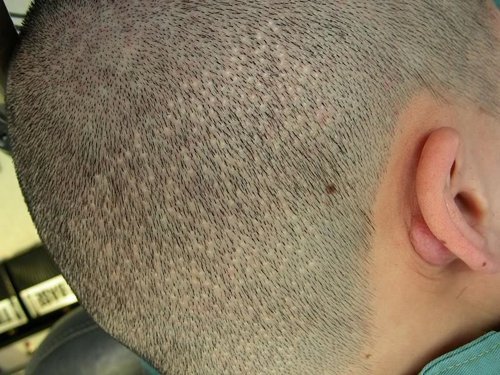
Ok, this is a patient report who just got 1000 traditional FUE grafts.
Yeah, you read it right - just 1000 traditional FUE grafts!
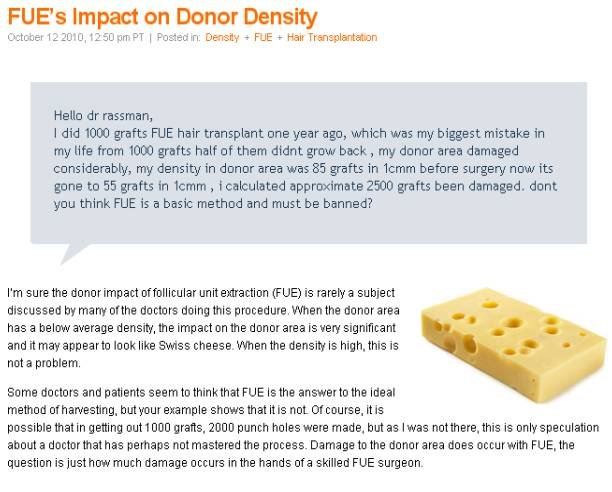
It is well known, and as mentioned by Rassman, of course, when your donor area has a below average density, the impact on the donor area is very significant, and the donor area could indeed appear
“to look like Swiss cheese” afterwards …
But if there would be RE-GROWTH in the donor area, where grafts were extracted, you simply can’t see anything - neither any white dots, nor any significant loss of density!
For instance, as you guys know, Wesley Sneijder got 1700 HST grafts and he always shaves his hair very short …
BEFORE Sneijder had his HST procedure, he never ever had a high donor density (according to lots of before photos). He rather had a below average density. Today, he can always shave his head as usual - and without any problems …
But maybe HST just works for celebrities … as claimed by Spanish Dud …
I’d be curious to see what his results look like when they’re grown out. It’s really not possible to tell the quality of the transplanted hair when he has it shaved to stubble. For the examples on the HASCI site, most of the guys have let their hair grow longer and it doesn’t look very good at all.
I know Joling lets his grow longer, but, heard he had a traditional transplant as well, so it’s tough to draw any conclusions off his case.
»
» Source: FUE’s Impact on Donor Density – WRassman,M.D. BaldingBlog
»
»
» Ok, this is a patient report who just got 1000 traditional FUE grafts.
» Yeah, you read it right - just 1000 traditional FUE grafts!
»
» It is well known, and as mentioned by Rassman, of course, when your donor
» area has a below average density, the impact on the donor area is very
» significant, and the donor area could indeed appear
» “to look like Swiss cheese” afterwards …
»
»
» But if there would be RE-GROWTH in the donor area, where grafts were
» extracted, you simply can’t see anything - neither any white dots, nor any
» significant loss of density!
»
» For instance, as you guys know, Wesley Sneijder got 1700 HST grafts
» and he always shaves his hair very short …
»
» http://www.inter.it/aas/squadra/player7?codgioc=G0856&L=en&lim=3
»
» BEFORE Sneijder had his HST procedure, he never ever had a high donor
» density (according to lots of before photos). He rather had a below average
» density. Today, he can always shave his head as usual - and without any
» problems …
»
» But maybe HST just works for celebrities … as claimed by Spanish Dud …
»
Iron_Man,
I do think an FUE HT expert should be able to see the extractions from 1,000 grafts by Dr Gho if he was not delivering regeneration, however, to be fair I do not think the example you are showing is a fine example of FUE.
Those extractions look very large to me (1mm ? ) and I think it can often be done much better than that.
» Iron_Man,
» I do think an FUE HT expert should be able to see the extractions
» from 1,000 grafts by Dr Gho if he was not delivering regeneration, however,
» to be fair I do not think the example you are showing is a fine example of
» FUE.
» Those extractions look very large to me (1mm ? ) and I think it can often
» be done much better than that.
DUTCH
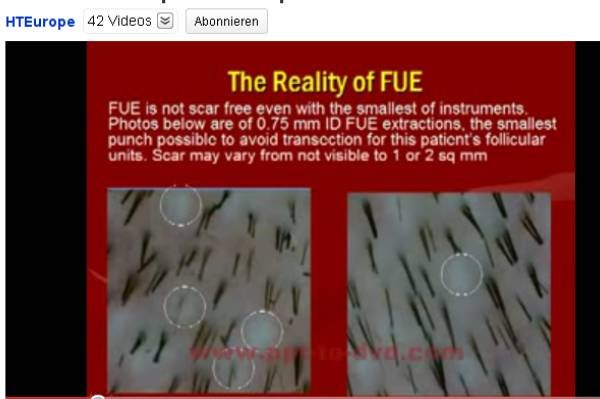
Bij meer dan 95% van de mensen varieert de doorsnede van een normaal haarfollikel tussen de 0,5 en 0,7mm. Aangezien de haarfollikels in groepjes van 2 tot 4 haren (follikel unit) in de hoofdhuid zitten en wij naalden van 0,5, 0,55 en 0,6 mm. gebruiken, is het bijna onmogelijk om te veel weefsel te oogsten. Bij een Follicular Unit Extraction (FUE) methode wordt de gehele haarfollikels verwijderd door middel van naalden tussen de 0,7 en 1,25mm. Hierdoor kan er bij FUE geen hergroei plaatsvinden.
GERMAN
Bei mehr als 95% der Menschen variiert der Durchmesser eines normalen Haarfollikels zwischen 0,5 und 0,7 mm. Da die Haarfollikel in Gruppen von 2 bis 4 Haaren (Follikel Einheiten) in der Kopfhaut auftreten, und wir Nadeln mit einem inneren Durchmesser von 0,5, 0,55 und 0,6 mm verwenden, ist es fast unmöglich dabei zu viel Gewebe zu ernten. Bei einer Follicular Unit Extraction (FUE) Methode werden die gesamten Follikel mit Nadeln zwischen 0,7 und 1,25 mm entfernt. Dadurch kann bei FUE kein Nachwachsen der Haare auftreten.
Meaning, NEITHER hair, NOR epidermis/skin regeneration …
The simple question still remains:
Why other HT doctors don’t use extraction needles between 0.5 and 0.6 mm inner diameter?
Why they use often almost twice the size?
IronMan i think i found a possible answer to this. Because they are not confident in themselves and therefore they wanna play it safe and extract the full organ just in case.
For example Cole is longer practising FUE and he uses smaller needles
» Try to translate the following into English …
» ------------------------------
» GERMAN
» Bei mehr als 95% der Menschen variiert der Durchmesser eines normalen
» Haarfollikels zwischen 0,5 und 0,7 mm. Da die Haarfollikel in Gruppen von 2
» bis 4 Haaren (Follikel Einheiten) in der Kopfhaut auftreten, und wir Nadeln
» mit einem inneren Durchmesser von 0,5, 0,55 und 0,6
» mm verwenden, ist es fast unmöglich dabei zu viel Gewebe zu
» ernten. Bei einer Follicular Unit Extraction (FUE) Methode werden die
» gesamten Follikel mit Nadeln zwischen 0,7 und 1,25
» mm entfernt. Dadurch kann bei FUE kein Nachwachsen der Haare
» auftreten.
» ------------------------------
»
» Meaning, NEITHER hair, NOR epidermis/skin regeneration …
Oh, and here is (one - besides many other) scientific proof:
EXCERPT
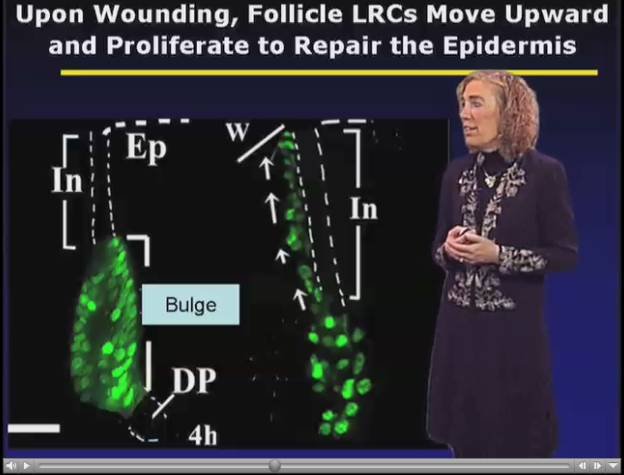
Hair follicles reconstitute themselves though the hair cycle, suggesting the presence of intrinsic stem cells. In contrast to the previous belief that stem cells reside in the bulbar region of hair follicles, stem cells were detected in the bulge area, a contiguous part of outer root sheath, that provides the insertion point for arrector pili muscle and marks the bottom of the permanent portion of hair follicles. The bulge cells are morphologically undifferentiated and slow-cycling under the normal conditions.
Later, studies successively demonstrated that bulge cells possess stem cell properties such as high proliferative capacity and multipotency to regenerate not only hair follicles but also sebaceous glands and epidermis.
Meaning, if you remove (via traditional FUE) the complete follicle(s), neither hair nor skin/epidermis regeneration. Result - white scar spots (hypopigmentation).
Whatever Cole is using (whether 0.9 or 1.25) he ALWAYS removes the WHOLE bulge area! Removing the whole bulge area = no hair re-growth and, in addition, hypopigmentation.
» » For example Cole is longer practising FUE and he uses smaller
» needles
»
» Ok, if you think needles between 0.9 and 1.25 mm in diameter are small …
»
» http://www.hairlossforum.net/library/article300.htm
»
» Whatever Cole is using (whether 0.9 or 1.25) he ALWAYS removes the WHOLE
» bulge area! Removing the whole bulge area = no hair re-growth and, in
» addition, hypopigmentation.
I remember reading that Dr Cole document, basically Dr Cole goes for FUE yield as his priority and thinks larger FUE tools don’t make a difference to scarring in the donor area - I have to say I do not think the results that we have seen since that paper came out bear out this theory - in fact quite the opposite.
The previous journal find was also very interesting and adds more weight to the HST position, thanks Iron_Man.
» I remember reading that Dr Cole document, basically Dr Cole goes for FUE
» yield as his priority and thinks larger FUE tools don’t make a difference
» to scarring in the donor area - I have to say I do not think the results
» that we have seen since that paper came out bear out this theory - in fact
» quite the opposite.
That’s the reason why he is so obsessed concerning the hypopigmentation issue and tries (for now with ACell) to improve this problem. But even with an ECM - practically NO WAY, at least not consistent enough, but enough for hyping it seems.
BUT, to my best knowledge, Dr. Cole has been THE ONE who at least tried to find reasons and more explanations for “FUE”. Actually, in fact, sometimes MORE science based than Rassman & Bernstein did it in their FUE paper they published in 2002. Actually, this paper did more harm, than good (it wasn’t a complete mistake, that Woods didn’t publish such a procedure).
This is an advertising site for paid
advertisers to showcase successful hair restoration results only. It is not the
mandate of this site to engage in the discussion of failed, unsuccessful
procedures, lawsuits, litigations, refunds or complaint cases. Surgical hair
restoration procedures carry risks. Please do thorough research, consult your
own physician and investigate a doctor's background carefully before making a
decision. By proceeding to use our site, you agree to abide by our Terms of Use & Privacy Policy at http://hairsite.com/terms-of-use/ where you can also find a list of HairSite's sponsoring physicians.