Frontal Hair Transplant: Hairline Design, Grafts & Recovery
Quick answer
Frontal hair transplant restores the hairline and temples with surgeon-led design. Typical Norwood 2–3 cases need 1,200–2,000 grafts; single-hair grafts and acute angles in the first 2 cm define naturalness. Results mature at 12–14 months.
Quick Numbers
Typical frontal grafts: 1,200–2,000 (Norwood 2–3)
Leading-edge angle: 10–15°
Leading-edge grafts: Singles only (0–7 mm)
Result benchmark: 12–14 months
Key Takeaways
• The first 2 cm defines whether a transplant looks natural.
• Single-hair grafts belong on the leading edge only.
• Hairline height must match age and loss pattern.
• Frontal incisions are surgeon-level work.
The frontal zone — especially the first 2 cm of the hairline — is what people see first in conversation and photographs. Frontal restoration succeeds when hairline design, graft selection, and incision angles are surgeon-led — not template-based.
This page covers typical graft counts (1,200-2,000 for Norwood 2-3), the three micro-zones of the leading edge, and how frontal work differs from crown priorities.
Compare zone goals with our crown hair transplant guide when Norwood patterns include vertex thinning that may need staged sessions after the hairline frame is established:
Aesthetic design principles for men and women are on our hairline design page when you are evaluating facial proportion rather than graft mechanics alone:
Why the frontal zone defines the result
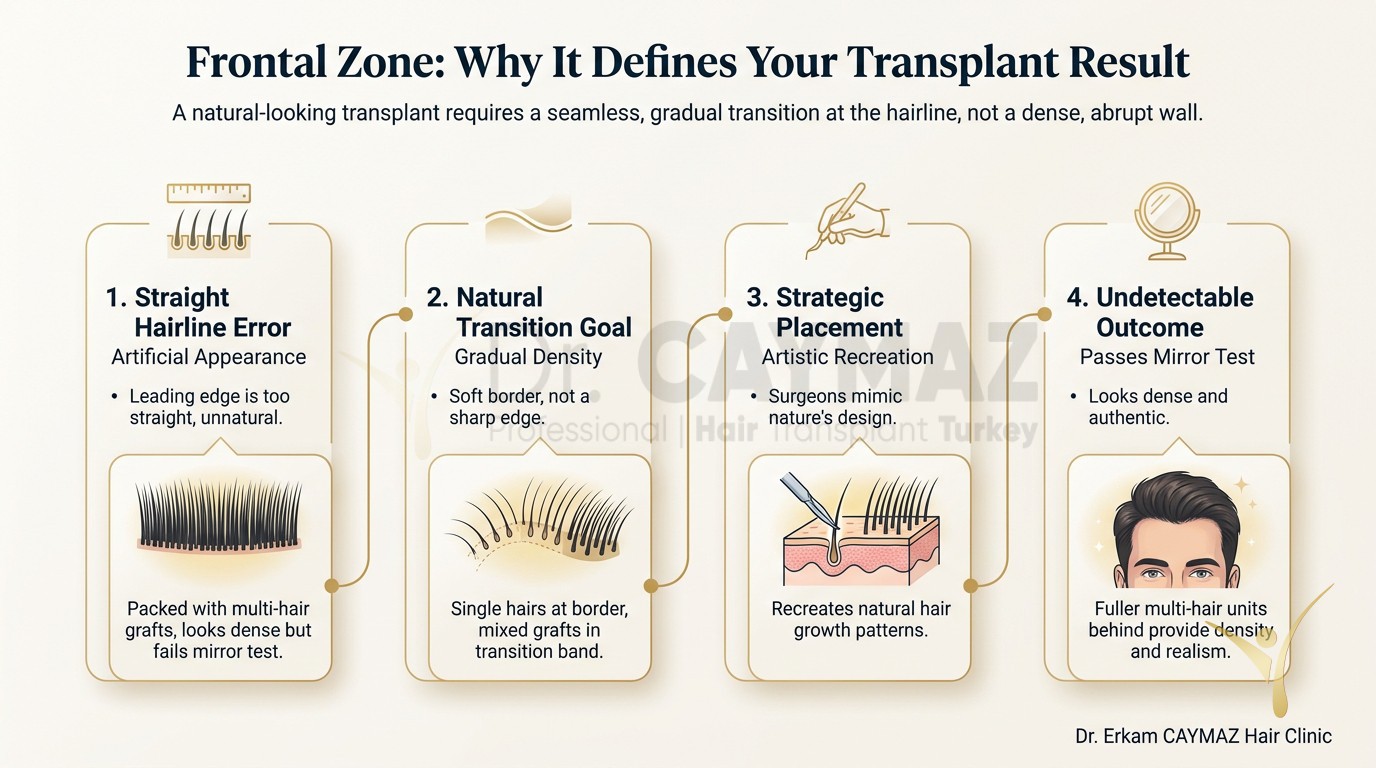
A transplant can look dense behind the hairline yet fail the mirror test if the leading edge is straight, too low, or packed with multi-hair grafts. Natural frontal hair transitions gradually: single hairs at the border, mixed grafts in the transition band, and fuller multi-hair units behind.
Surgeons recreate this with deliberate micro-irregularity, acute exit angles (10–15° at the front row), and age-appropriate placement based on Norwood stage and family history — not a fixed centimeter measurement copied from photos.
Dr. Caymaz Insight
I draw every VIP hairline with the patient sitting upright — never lying flat. The first 5–7 mm get only single-hair grafts at acute angles. That narrow band decides whether the result looks grown or planted.
— Dr. Erkam Caymaz
Three micro-zones in the first 2 cm

Leading edge (0-7 mm): single-hair grafts only, wider spacing (~15-20 grafts/cm2).
Transition band (7-15 mm): mix of singles and doubles (~25-35 grafts/cm2).
Density zone (15-20 mm): two- and three-hair grafts for fullness (~40-50 grafts/cm2).
Read the deep-dive in our frontal hairline design anatomy article for millimeter-level specs on angles, spacing, and the first 2 cm micro-zones before you compare older blog summaries:
Single-graft mechanics, golden-ratio proportion, and temple-point direction each have dedicated articles in the hairline cluster when you need technique detail beyond this pillar overview.
Start with single grafts in the hairline when evaluating whether a leading edge looks soft and irregular rather than pluggy under bright bathroom lighting:
Facial proportion references appear in golden ratio hairline creation when donor reserve and age-appropriate placement need a mathematical starting frame before surgeon judgment finalises the border:
Temple framing and downward graft direction are covered in temple point design for patients whose recession breaks the frontal frame at the sideburn transition:
Technique: Sapphire FUE and DHI in the frontal third
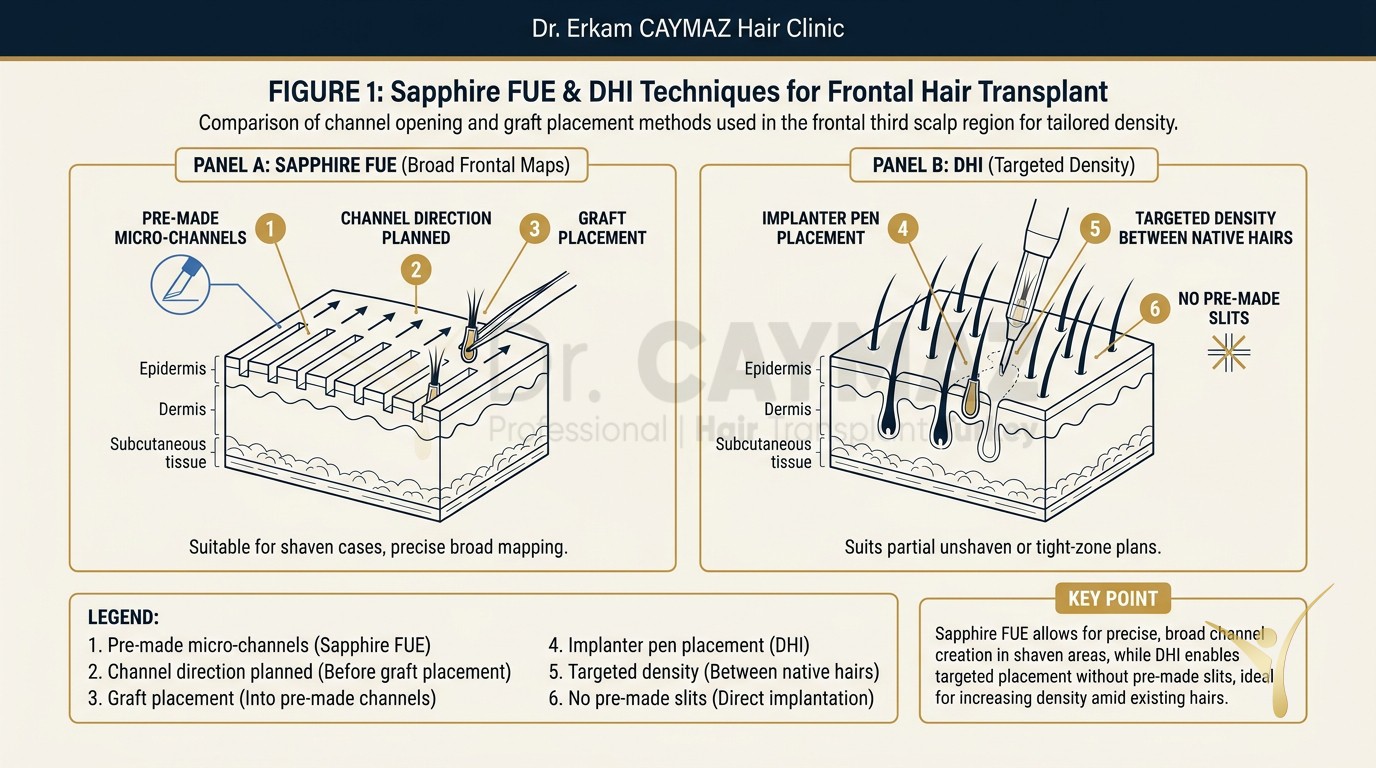
Sapphire FUE opens precise micro-channels for broad frontal maps in many shaven cases where channel direction is planned before any graft is placed by the surgical team:
In partial unshaven or tight-zone plans, DHI suits targeted density between native hairs when implanter placement replaces pre-made slits for selected recipient rows:
Compare zone-by-zone trade-offs on our DHI vs Sapphire FUE page before consultation so you can match tool choice to hairline, temple, and mid-scalp goals rather than a marketing label:
In VIP care, Dr. Erkam Caymaz personally designs the hairline and creates frontal incisions (The Architect Touch); extraction and implantation run under direct supervision rather than template-based technician-only workflows common in high-volume clinics:
Staging with crown work and recovery
Norwood 4 and above often need staged sessions; our hairline versus crown surgical plans guide explains typical sequencing when donor reserve is finite and mid-scalp progression remains a concern:
Shock shedding weeks 2-6 is normal while transplanted shafts shed before new growth begins; judge frontal density at 12-14 months, not before one year.
Structured aftercare protocols protect grafts through the first weeks when crusts soften, swelling settles, and friction from hats or helmets must stay limited:
Medicated rinses transition to gentle shampoo on a clinic-defined timeline; dislodging grafts during the first wash attempts is a common early mistake international patients make when rushing home routines.
Step-by-step timing is published on our hair wash after transplant page so you know when crusts may be softened without rubbing the leading edge:
Frontal zone vs crown / vertex
Parameter | Frontal hairline | Crown / vertex
Leading-edge graft type | Single-hair grafts only | No defined leading edge
Incision angle | 10–15° (very acute) | 30–45° (moderate)
Typical graft count | 1,200–2,000 | 1,500–3,500
Surgeon involvement | Hairline drawing + incisions | Whorl mapping + incisions
Clinical Intelligence Panel — Frontal Hair Transplant
Clinical Context
The frontal zone, especially the first 2 cm of the hairline, defines whether a transplant looks natural or operated. Single-hair grafts, acute exit angles, and age-appropriate placement are surgeon-level decisions.
Candidate Profile
Norwood 2–4 with receding temples or frontal thinning, stable or medically managed loss, and donor reserve for 1,200–2,500 grafts in the frontal third. Expectations must account for future progression.
Key Risk
A hairline set too low or too straight, multi-hair grafts at the leading edge, or uniform graft direction without a radial fan, creating a pluggy or juvenile frame that ages poorly.
Expected Outcome
With surgeon-led hairline design and sapphire or DHI placement in the frontal zone, overall success is about 90–95% and graft survival up to 98%; cosmetic maturity at 12–14 months.
Hairline Zones
Q: What are the three micro-zones in the first 2 cm?
A: Leading edge (0–7 mm): singles only. Transition band (7–15 mm): mix of 1- and 2-hair grafts. Density zone (15–20 mm): 2- and 3-hair grafts for fullness behind a soft border.
Q: What angle should frontal grafts use?
A: Leading-edge grafts exit at 10–15° relative to the scalp surface. Steeper angles create bristle-like hair that does not lie naturally.
Q: How many grafts for a frontal hairline?
A: Norwood 2–3 often needs 1,200–2,000 grafts including temporal points. Wider recession or temple work increases the range.
Q: How is hairline height chosen?
A: Facial thirds and golden-ratio references guide placement, but age, loss pattern, and donor reserve override fixed centimeter rules.
Technique Choice
Q: Sapphire FUE or DHI for the frontal zone?
A: Sapphire FUE opens slits first for broad frontal maps; DHI suits targeted density between native hairs or partial unshaven work. Many VIP cases combine both by zone.
Q: Who should make frontal incisions?
A: Hairline design and recipient incisions in the frontal third are surgeon responsibilities, not delegable template work.
Q: When are temporal points included?
A: When temple recession breaks facial framing. Temporal grafts need downward and slightly backward direction distinct from central forward-facing hairs.
Common Pitfalls
Q: What makes a hairline look fake?
A: Straight ruler-drawn borders, no single-graft soft edge, hairline placed too low for age, or all hairs pointing one direction without a fan pattern.
Q: Can a bad hairline be revised?
A: Yes, often by adding singles in front of an existing row or adjusting density in the transition zone. Scar tissue from prior work makes correction harder.
Q: Why draw the hairline upright?
A: Forehead skin drapes differently lying vs sitting. Design with the patient upright matches how the line reads in conversation and photos.
Evidence Snapshot
Q: When does frontal growth appear?
A: Initial sprouts often at months 3–4; about 80% visible by months 8–10. Frontal skin thickness can delay growth slightly vs mid-scalp.
Q: Is shock loss normal in the hairline?
A: Yes, temporary shedding weeks 2–6 is expected. Follicles remain intact beneath the skin.
Q: What survival rates apply?
A: Up to 98% graft survival with proper technique and aftercare; overall success 90–95% when planning and compliance align.
Action Plan
Q: What to review before booking frontal work?
A: Close-up 12+ month hairline photos, who designs and opens channels, graft range within donor limits, and staging plan if crown loss is also present.
Q: How should frontal VIP days run?
A: Consultation hairline drawing, surgeon-led incisions, limited daily case volume, and structured aftercare briefing before travel home.
Q: What protects the frontal zone after surgery?
A: Gentle washing per clinic schedule, sleep position guidance, sun avoidance early, and reporting graft displacement in the first days.
Key Takeaway
Frontal transplants are won or lost in the first 5–7 mm, singles, micro-irregularity, and acute angles matter more than headline graft totals.
Clinical Pearl
I never use a universal hairline template. Every frontal design follows that patient’s bone structure, age, and projected future loss, drawn with them sitting upright.
Red Flag
A clinic that cannot show healed frontal close-ups, delegates all incisions to technicians, or promises a teenage hairline on a middle-aged patient.
Monitoring Point
Assess hairline naturalness at 12–14 months; if native loss continues behind the transplanted line, medical therapy or a second session may be needed to maintain cohesion.
FAQ
Q: How many grafts are needed for a frontal hair transplant?
A: Norwood 2–3 patients often need 1,200–2,000 grafts including temporal points. Wider recession increases the range.
Q: Should only single-hair grafts be used at the hairline?
A: Only in the first 5–7 mm. Behind that, a transition band mixes singles and doubles before fuller multi-hair grafts add density.
Q: What angle should frontal grafts use?
A: Leading-edge grafts exit at 10–15° relative to the scalp surface to mimic natural forward-growing hair.
Q: Sapphire FUE or DHI for the frontal zone?
A: Sapphire FUE suits broad frontal maps; DHI suits targeted work between native hairs. Many VIP cases combine both by zone.
Q: Can frontal and crown be done together?
A: Advanced patterns often need staged sessions spaced at least six months apart to protect the donor area.
Q: When will the frontal hairline look full?
A: Initial growth often begins at months 3–4; assess final density at 12–14 months after shock shedding resolves.
Q: Can a bad hairline be corrected?
A: Revision can soften harsh lines with additional single-hair grafts in front of the existing row. Prior scar tissue makes correction harder.
Q: How is hairline height chosen?
A: Facial thirds and golden-ratio references guide placement, but age, loss pattern, and donor reserve override fixed measurements.
Sources & clinical references
• PubMed — direct hair implantation versus FUE technique comparison
• PubMed — FUE versus DHI hair transplantation
• PubMed — hairline design hair transplantation
• PubMed — hair transplant candidate selection Norwood
Full guide: Frontal Hair Transplant | Dr. Caymaz
Dr. Erkam Caymaz — Istanbul: Dr. Erkam Caymaz | Hair Transplant Surgeon in Istanbul