Patient Overview
-
Patient Gender: Female
-
Age Group: Early-30s to Mid-30s
-
Hair Loss Condition: Frontal hairline thinning with widening of the central parting and reduced frontal density
-
Hair Loss Pattern: Female Pattern Hair Loss (Ludwig Grade I–II)
-
Procedure Performed: I-FUE Hair Transplant
-
Total Grafts Implanted: 1950 Grafts
-
Result Timeline: 10 Months After Hair Transplant
Areas Treated
-
Frontal Hairline
-
Frontal Scalp
-
Central Hairline
-
Front Hair Density
After a detailed scalp analysis and consultation, our hair restoration specialists created a personalized treatment plan to:
-
Restore a softer, feminine hairline
-
Improve frontal scalp density
-
Reduce the appearance of scalp visibility
-
Create a naturally fuller hairstyle
-
Maintain a balanced facial appearance
-
Preserve donor hair for future requirements
-
Deliver long-lasting, natural-looking results
Every female hair transplant at Hairfree & Hairgrow Clinic India is customized according to the patient’s facial features, hair texture, donor availability, and future hair loss progression.
Hair Loss Before Hair Transplant
Before undergoing the procedure, the patient experienced gradual thinning along the frontal scalp and central hairline, making the scalp more visible while styling or tying her hair.
Primary Concerns
-
Receding frontal hairline
-
Widening hair partition
-
Reduced frontal density
-
Visible scalp near the front
-
Difficulty creating fuller hairstyles
-
Loss of confidence due to thinning hair
-
Progressive female pattern hair loss
Fortunately, the donor area showed adequate density, making her a suitable candidate for an I-FUE hair transplant.
Personalized Hair Restoration Planning
A successful female hair transplant requires careful planning rather than simply increasing the number of grafts.
Before surgery, our medical team evaluated:
-
Female hair loss pattern
-
Donor hair density
-
Hair shaft thickness
-
Facial proportions
-
Existing hair direction
-
Hairline aesthetics
-
Future hair loss progression
-
Donor preservation strategy
Based on this assessment, 1950 grafts were strategically implanted to maximize coverage in the frontal region while preserving donor follicles for long-term hair restoration needs.
Natural Female Hairline Design
Unlike male hair transplants, female hairline restoration requires a softer and more delicate design.
Our surgeons carefully created the following:
-
Naturally rounded feminine hairline
-
Soft irregular frontal edges
-
Proper hair angulation
-
Balanced facial proportions
-
Natural hair growth direction
-
Seamless blending with existing hair
-
Age-appropriate density
The objective was to enhance facial aesthetics while ensuring the transplant remained virtually undetectable.
1950 Grafts I-FUE Hair Transplant Procedure
Considering the patient’s pattern of hair loss, our surgical team performed an advanced I-FUE hair transplant using 1,950 carefully selected follicular unit grafts.
Areas Covered
-
Frontal Hairline
-
Frontal Scalp
-
Central Hairline
-
Front Density
Advanced Implantation Technique
To achieve natural results, every follicular unit was implanted according to the patient’s existing hair growth pattern.
The procedure included:
-
Single-hair grafts along the frontal edge
-
Precision implantation for female hairline design
-
High-density frontal placement
-
Natural graft angulation
-
Uniform graft distribution
-
Minimal trauma to surrounding follicles
-
Advanced graft preservation for excellent survival
This meticulous approach resulted in fuller density while maintaining a soft, natural appearance.
Hair Growth Timeline
Month 1–3
The transplanted hair entered the normal shedding phase while the follicles established themselves within the scalp.
Month 3–5
New hair growth became visible across the frontal hairline and central scalp.
Month 5–7
Hair density steadily improved, and scalp visibility became noticeably reduced.
Month 7–9
The transplanted hair became thicker, stronger, and blended naturally with the surrounding hair.
Month 10
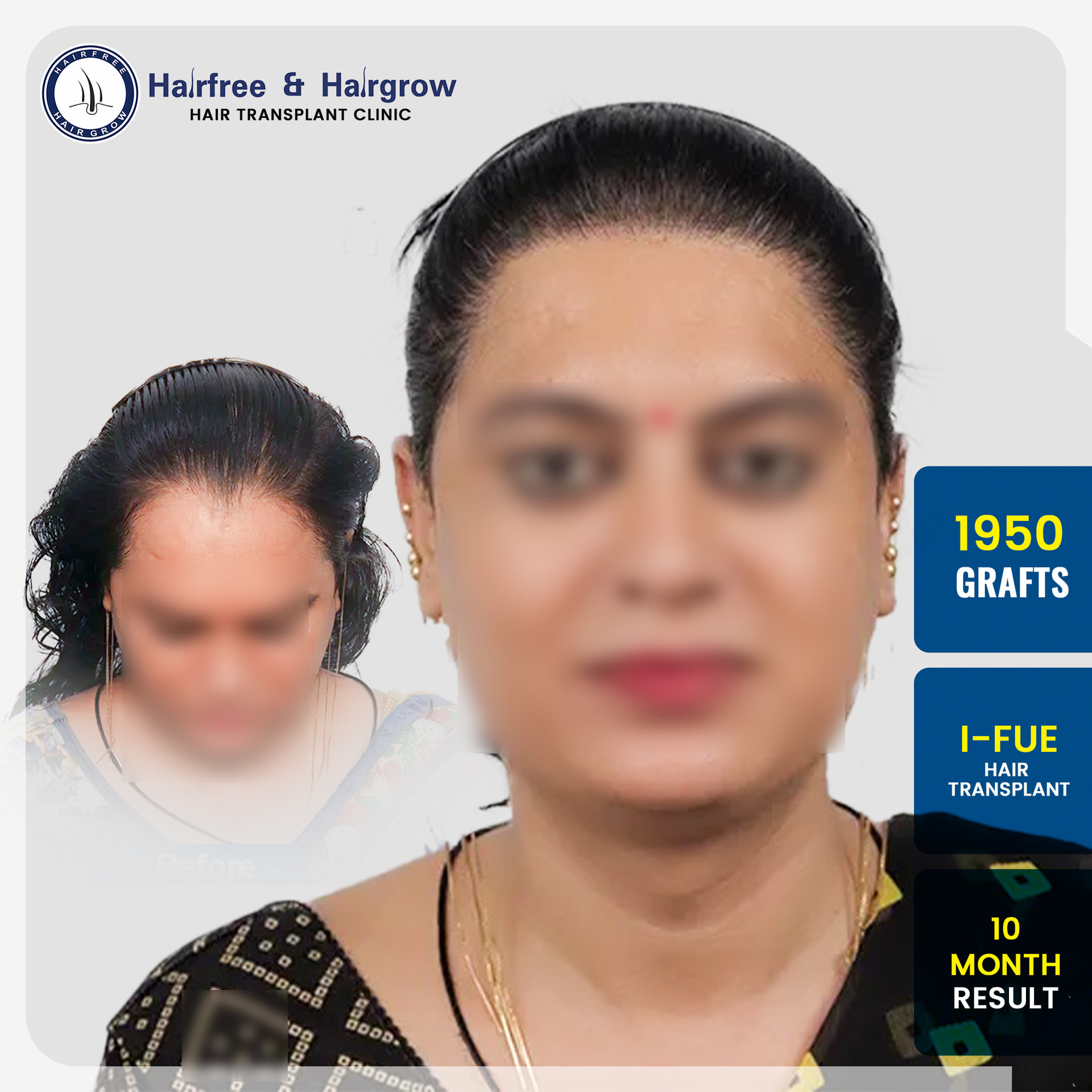
At the ten-month mark, the patient achieved excellent frontal density, a natural feminine hairline, and significantly improved overall hair fullness.
Hair Transplant Results After 10 Months
The transformation after 10 months demonstrates how a well-planned female hair transplant can restore both hair density and confidence.
Before Hair Transplant
-
Thin frontal hairline
-
Widening hair partition
-
Visible scalp
-
Reduced frontal density
-
Limited hairstyle options
-
Lower confidence
After 10 Months
-
Natural feminine hairline
-
Fuller frontal scalp
-
Improved hair density
-
Reduced scalp visibility
-
Healthy hair growth
-
Better facial framing
-
More styling flexibility
-
Enhanced confidence
The transplanted hair blends naturally with the patient’s existing hair, creating results that are difficult to distinguish from natural hair growth.
Final Results Achieved
Following the 1950 grafts I-FUE hair transplant, the patient achieved the following:
-
Natural-looking female hairline
-
Improved frontal scalp density
-
Fuller central hairline
-
Reduced scalp visibility
-
Thick, healthy hair growth
-
Natural hair direction
-
Long-lasting hair restoration
-
Improved facial aesthetics
-
Increased confidence
Why This Female Hair Transplant Case Stands Out
This case highlights how a strategically planned 1950s graft I-FUE Hair transplants can effectively treat female-pattern hair loss while preserving natural density and feminine facial harmony.
Patients searching for the best female hair transplant in India often look for natural hairline design, high graft survival, and long-term results goals that are reflected in this personalized treatment approach.
Case Highlights
-
1950 strategically implanted grafts
-
Advanced I-FUE Hair Transplant
-
Natural female hairline reconstruction
-
High graft survival
-
Improved frontal density
-
Minimal downtime
-
Excellent 10-month outcome
-
Permanent, natural-looking results
Frequently Asked Questions
Is 1950 grafts enough for a female hair transplant?
For women experiencing mild to moderate frontal thinning, approximately 1950 grafts can provide excellent improvement in the frontal hairline and front scalp. The exact number depends on donor density, hair characteristics, and treatment goals.
When will I see full hair transplant results?
Most patients begin seeing new hair growth within 3 to 5 months. Significant improvement usually occurs between 8 and 10 months, while complete hair maturation may continue for up to 12 to 18 months.
Is an I-FUE hair transplant permanent?
Yes. Hair follicles transplanted from the donor area are generally resistant to hair loss and continue growing naturally for many years with proper care.
Does an I-FUE hair transplant leave scars?
I-FUE is a minimally invasive technique that does not leave a linear scar. Tiny extraction sites heal quickly and are usually barely noticeable.
Can women style and color transplanted hair?
Yes. Once the transplanted follicles have matured, the hair can be washed, cut, colored, and styled just like natural hair.
Conclusion
These 1,950 grafts from an I-FUE hair transplant demonstrate how advanced hair restoration can successfully improve female-pattern hair loss by restoring the frontal hairline and increasing scalp density. After just 10 months, the patient achieved fuller, healthier-looking hair with a natural feminine appearance and renewed confidence.
At Hairfree & Hairgrow Clinic India, every female hair transplant is individually planned to achieve natural density, preserve donor hair, and deliver long-lasting results tailored to each patient’s unique hair loss pattern.