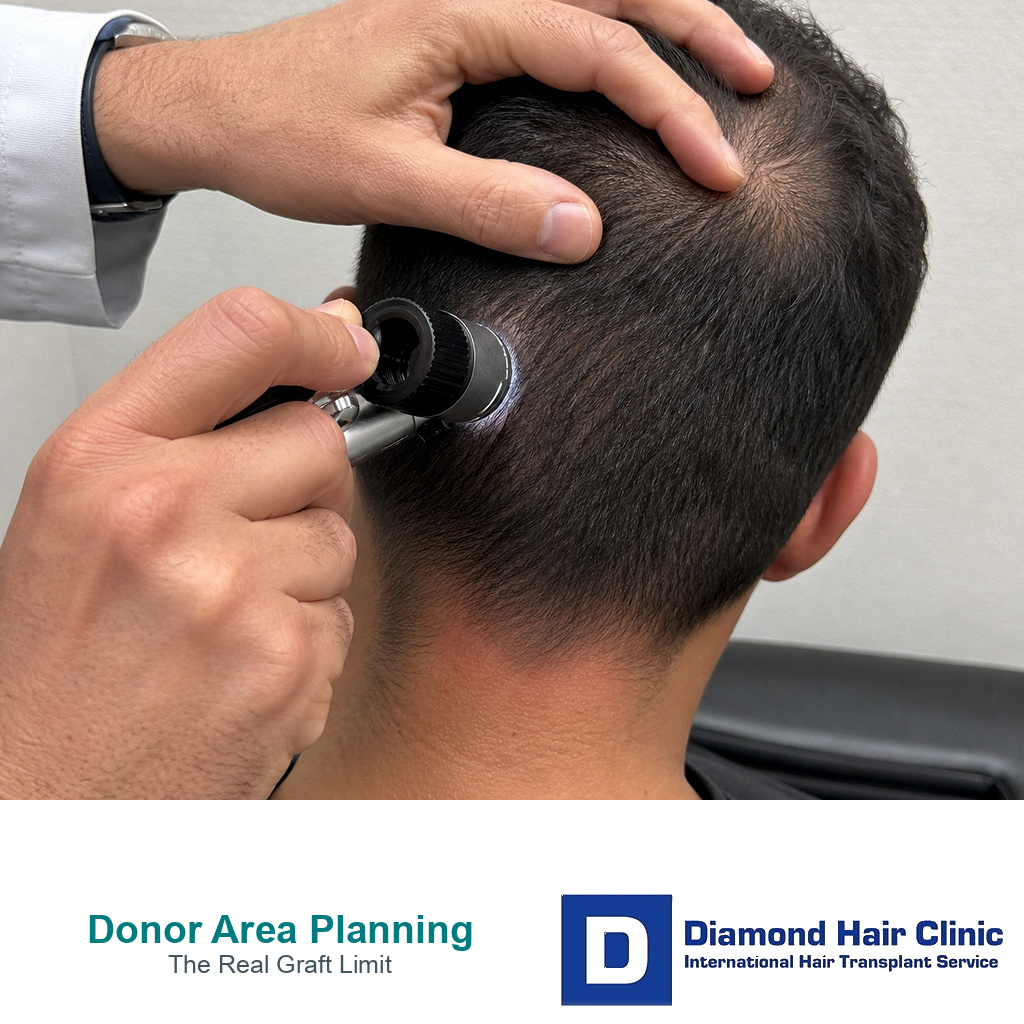
When a patient asks how many grafts he needs for coverage, I do not begin with a number.
I begin with the donor area examination.
I have learned that again and again in hair restoration surgery.
The donor area is not a bank account with endless grafts!
It has a real limit, and that limit differs for every hair loss patient.
Hair thickness, density, the way the hair exits the scalp, the size of the crown, the strength of the right and left sides, and future hair loss pattern all change the surgery master plan.
A high graft number can sound attractive on paper.
But if those grafts are taken without respect for the donor area, the patient may pay for it later with a thin, patchy, overharvested look.
My job is not to take the maximum graft number possible.
As a surgeon, my job is to decide how many grafts I can use wisely.
Sometimes a patient wants the front, temples, mid scalp, and crown treated together.
I understand that wish.
But if the donor area can’t safely support that plan, I prefer to explain the limitation clearly rather than pretend every area can be restored with the same density.
A good hair transplant should improve the face, protect the donor area, and keep future options open.
That is why I am careful with aggressive promises, especially for young patients or those with ongoing active hair loss.
Before you compare clinics by graft number, ask what the surgeon is protecting.
The donor area is usually the last thing patients look at.
For me, it is one of the first things I study.
Once donor hair is used poorly, we cannot simply create a new donor area later.
Dr. Mehmet Demircioglu
Diamond Hair Clinic
Istanbul, Turkey
#diamondhairclinic #drmehmetdemircioglu #hairtransplant hairtransplantturkey #hairtransplantistanbul #fuehairtransplant #donorarea #donorareamanagement #hairtransplantplanning #graftnumber hairrestoration #naturalhairline #recedinghairline hairloss #hairtransplantconsultation