Patient Overview
-
Patient: Rahul Mankar
-
Gender: Male
-
Age Group: Early 30s
-
Hair Loss Grade: Norwood Grade V Male Pattern Baldness
-
Procedure: I-FUE Hair Transplant
-
Total Grafts Implanted: 4,000 Grafts
-
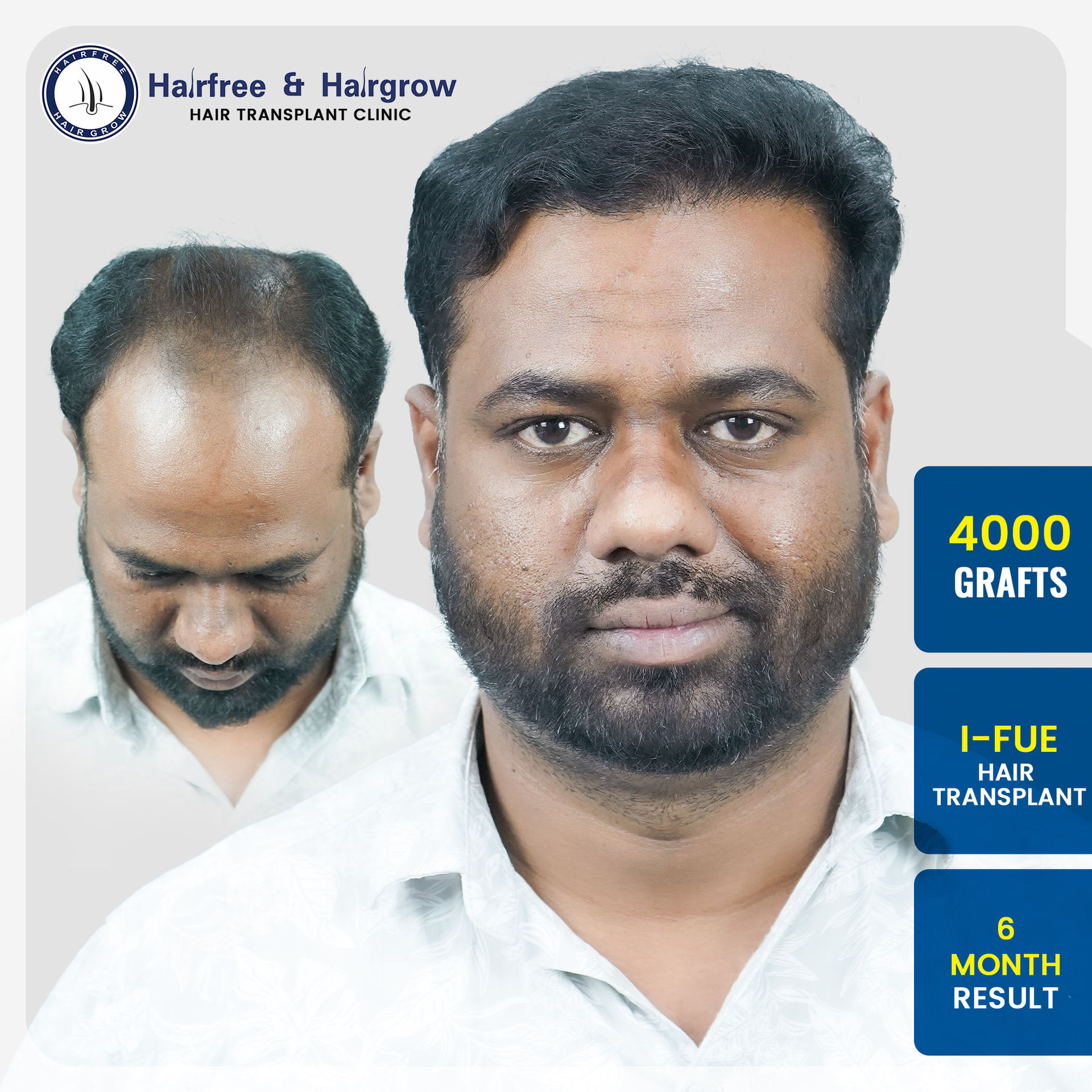
Result Status: 6-Month Hair Transplant Result
Treatment Areas
-
Frontal Hairline Reconstruction
-
Frontal Scalp Restoration
-
Mid-Scalp Coverage
-
Density Enhancement
-
Natural Hairline Design
Patient’s Hair Loss Before Hair Transplant
Before undergoing his I-FUE hair transplant in Pune, Rahul was experiencing advanced Norwood Grade V male-pattern baldness, with extensive hair loss affecting the frontal hairline and front-to-mid-scalp region. The progressive recession resulted in a significantly enlarged forehead, visible scalp, and reduced hair density, making styling increasingly difficult.
Although hair loss had progressed considerably in the frontal region, the donor area at the back and sides of the scalp remained healthy, providing an excellent source of permanent follicular units for transplantation.
Following a detailed consultation and scalp evaluation, our surgeons recommended a 4,000-graft I-FUE hair transplant to restore a natural hairline and improve overall scalp density while preserving donor hair for long-term planning.
Primary Hair Loss Concerns
-
Advanced frontal hairline recession
-
Large visible bald area
-
Extensive frontal scalp thinning
-
Reduced hair density
-
Prominent forehead appearance
-
Difficulty styling hair
-
Older appearance due to hair loss
-
Loss of confidence
Comprehensive Hair & Donor Assessment
Before surgery, our experienced hair transplant surgeons performed a comprehensive scalp and donor evaluation to develop a personalized treatment plan.
The assessment included:
-
Norwood grade classification
-
Donor hair density analysis
-
Hair shaft thickness evaluation
-
Follicular unit quality assessment
-
Scalp elasticity examination
-
Hair growth pattern analysis
-
Future hair loss prediction
-
Donor preservation planning
-
Facial symmetry and proportion analysis
This comprehensive evaluation ensured optimal graft allocation and natural-looking long-term results.
Personalized I-FUE Hair Transplant Planning
Every successful hair transplant begins with meticulous planning.
Rather than focusing only on graft numbers, our surgeons designed a customized surgical approach to achieve the following:
-
Natural frontal hairline
-
High-density frontal restoration
-
Balanced mid-scalp coverage
-
Maximum cosmetic improvement
-
Long-term donor preservation
-
Natural hair growth direction
-
Age-appropriate hairline
The goal was to create a result that blends seamlessly with the patient’s facial features while maintaining flexibility for any future hair loss.
Natural Hairline Design
Hairline design is one of the most important aspects of a successful hair transplant.
For Rahul, our surgeons designed a customized hairline based on:
-
Facial proportions
-
Age
-
Existing hair characteristics
-
Hair texture
-
Future hair loss pattern
-
Natural hair direction
Hairline Design Features
-
Soft, irregular frontal hairline
-
Single-hair grafts at the leading edge
-
Gradual density progression
-
Natural graft angulation
-
Correct hair direction
-
Symmetrical facial balance
The reconstructed hairline was designed to appear natural from every angle and continue looking authentic as the transplanted hair matures.
I-FUE Hair Transplant Procedure
Rahul underwent an advanced I-FUE hair transplant involving 4,000 carefully selected follicular unit grafts.
Treatment Areas
-
Frontal Hairline
-
Front Scalp
-
Mid-Scalp
-
Density Enhancement
Surgical Highlights
-
4,000 graft implantations
-
Advanced I-FUE extraction technique
-
Precision recipient site creation
-
High graft survival protocol
-
Uniform graft distribution
-
Natural implantation angles
-
Minimal trauma to donor and recipient areas
-
Advanced graft preservation methods
Every graft was implanted according to the patient’s natural hair growth pattern to maximize density and achieve a realistic appearance.
6-Month Hair Transplant Result
At 6 months after surgery, Rahul has already achieved significant improvements in both hairline definition and frontal scalp density.
The photographs demonstrate:
-
Well-defined natural hairline
-
Excellent frontal coverage
-
Improved scalp density
-
Healthy hair growth progression
-
Natural hair direction
-
Balanced facial appearance
-
Strong graft survival
-
Visible cosmetic transformation
Although impressive improvement is already visible at six months, transplanted hair continues to mature, becoming thicker and denser in the months to come.
Hair Growth Timeline
Week 1
Initial healing with mild redness and temporary scabbing around the implanted grafts.
Month 1
The transplanted follicles become securely established while the scalp heals completely.
Months 2–3
Temporary shedding occurs as part of the normal hair growth cycle.
Months 4–6
New hair begins growing consistently with noticeable improvements in hairline definition and density.
Months 7–9
Hair becomes thicker, fuller, and stronger with improved cosmetic density.
Months 10–12
Most patients achieve substantial cosmetic improvement with mature, natural-looking results.
12–18 Months
Hair continues to mature in thickness, texture, and overall density, delivering the final outcome.
Expected Final Results
Before Hair Transplant
-
Advanced frontal hairline recession
-
Extensive frontal baldness
-
Low hair density
-
Visible scalp
-
Larger forehead appearance
-
Limited hairstyling options
After Full Hair Growth
-
Natural-looking hairline
-
Fuller frontal scalp
-
Improved density
-
Better facial balance
-
Younger appearance
-
Permanent hair restoration
-
Greater styling flexibility
-
Natural hair direction
Why This Hair Transplant Case Is Unique
This case demonstrates how a strategically planned 4,000-graft I-FUE hair transplant can successfully restore advanced frontal hair loss while maintaining a completely natural appearance.
Instead of simply maximizing graft numbers, our surgeons prioritized the following:
-
Artistic hairline reconstruction
-
Strategic graft placement
-
High cosmetic density
-
Natural hair direction
-
Long-term donor preservation
-
High graft survival
-
Balanced facial aesthetics
The patient’s outstanding 6-month progress reflects meticulous planning and precision surgical execution, with further improvement expected over the coming months.
Hair Transplant Case Highlights
-
4,000 Grafts Implanted
-
Advanced I-FUE Hair Transplant
-
6-Month Hair Transplant Result
-
Norwood Grade V Hair Loss
-
Natural Hairline Reconstruction
-
High-Density Frontal Restoration
-
Frontal & Mid-Scalp Coverage
-
Customized Surgical Planning
-
Permanent Hair Restoration
-
Minimally Invasive Hair Transplant Technique
Frequently Asked Questions
Is the 6-month result the final outcome?
No. While significant hair growth is visible at six months, transplanted hair continues to mature in thickness, texture, and density for up to 12–18 months after surgery.
Why were 4,000 grafts required?
The patient had advanced frontal and mid-scalp hair loss consistent with Norwood Grade V baldness. A larger graft count was necessary to achieve natural coverage and optimal cosmetic density.
What is an I-FUE hair transplant?
I-FUE (Improved Follicular Unit Extraction) is an advanced minimally invasive hair transplant technique that involves extracting and implanting individual follicular units with precision. It is designed to maximize graft survival, ensure natural-looking results, and minimize recovery time.
Will the transplanted hair be permanent?
Yes. The transplanted follicles are harvested from the donor area, which is generally resistant to male pattern baldness. With proper care, these follicles continue to grow naturally for many years.
When will the final hair transplant results be visible?
Most patients experience significant improvement between 9 and 12 months, while complete maturation, including increased thickness and density, may continue for up to 18 months.