Disclaimer
Individual hair transplant results vary depending on age, genetics, hair-loss pattern and progression, donor hair quality, medical history, medications, lifestyle, and adherence to post-operative care. This case study represents one patient’s individual treatment experience and should not be considered a guarantee of identical results for other individuals.
Patient Overview
-
Gender: Male
-
Procedure: I-FUE Hair Transplant
-
Total Grafts Implanted: 4,500 grafts
-
Result Timeline: 1 year 10 months
-
Primary Treatment Concern: Extensive scalp hair thinning and reduced hair density
-
Treatment Focus: Frontal and mid-scalp restoration with improved overall scalp coverage
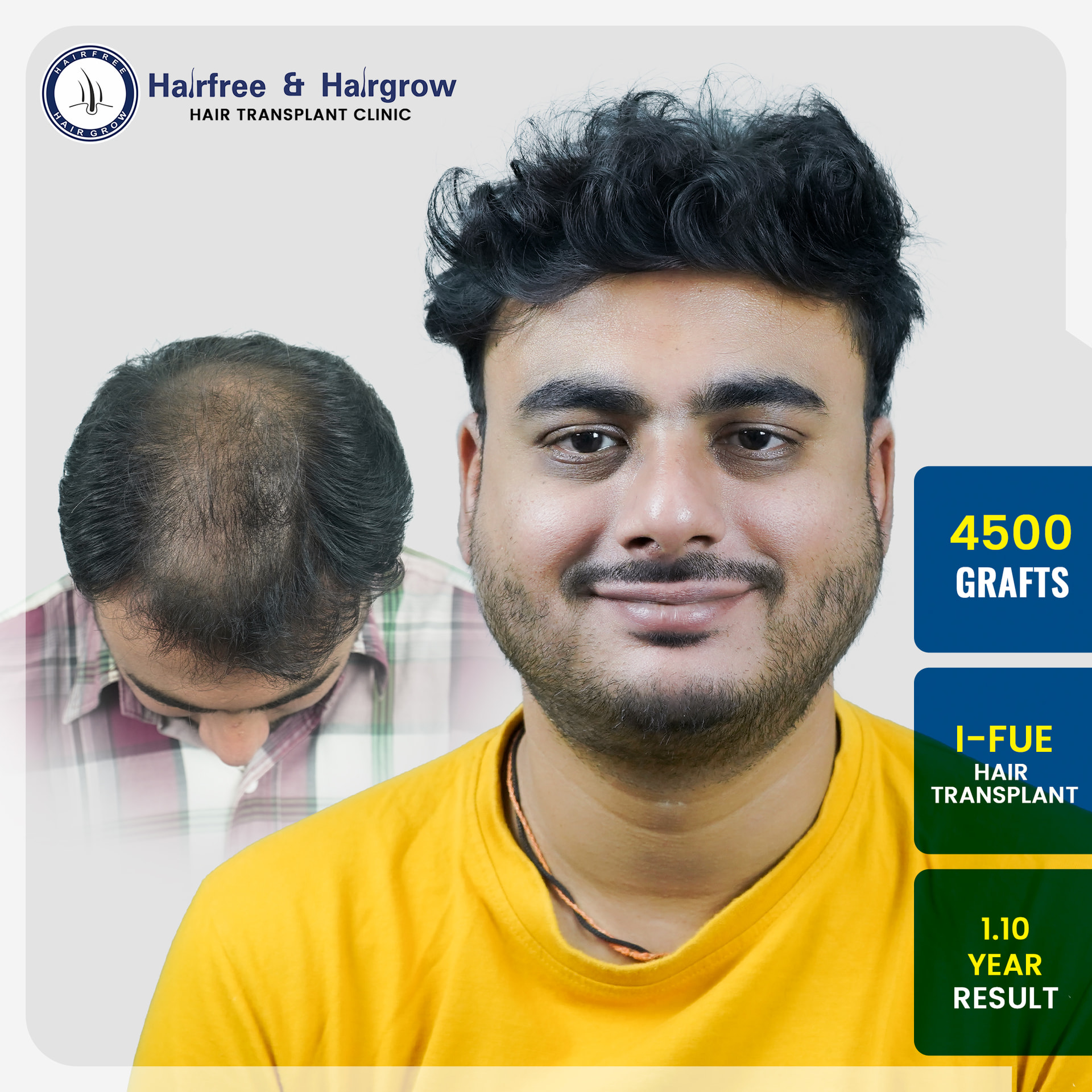
Overview
This case presents the hair transplant journey of a male patient who underwent an I-FUE hair transplant** involving 4,500 grafts** to address significant scalp hair thinning and reduced density.
The pre-treatment photograph shows noticeable thinning across the top and crown region, with increased scalp visibility. The follow-up photograph, taken approximately 1 year and 10 months after the procedure, shows a substantially fuller overall appearance with improved scalp coverage.
The long-term follow-up provides a useful view of the patient’s mature hair-growth progress following a large graft transplant.
Hair Loss Before the Hair Transplant
Before treatment, the patient displayed visible hair thinning across the upper scalp. The reduced density allowed more of the scalp to become visible, particularly through the central and crown areas.
The surrounding hair remained comparatively stronger, creating a noticeable contrast between the thinning recipient region and the denser hair around it.
Primary Hair Loss Concerns
-
Significant scalp hair thinning
-
Reduced hair density across the top
-
Increased scalp visibility
-
Thinning in the crown and mid-scalp region
-
Reduced overall hair coverage
-
Difficulty achieving a fuller hairstyle
-
Need for comprehensive scalp restoration
Hair and Donor Area Assessment
A hair transplant requires assessment of both the recipient and donor areas before graft placement. Donor hair availability, follicular characteristics, existing density, hair-loss progression, and the size of the recipient area all influence treatment planning.
For this case, 4,500 grafts were transplanted to provide broader coverage across the areas affected by hair thinning.
Key assessment considerations include the following:
-
Hair-loss pattern and severity
-
Donor-area density
-
Hair caliber and characteristics
-
Recipient-area size
-
Existing native-hair distribution
-
Scalp visibility
-
Desired coverage
-
Natural hair-growth direction
-
Long-term hair-loss progression
-
Responsible donor-area management
Personalized Hair Transplant Planning
Because the patient had noticeable thinning across a relatively broad scalp area, the treatment required strategic distribution of a substantial number of grafts.
The objective was not simply to place grafts into the scalp but to distribute them across the areas requiring coverage while maintaining an appropriate transition between transplanted and existing native hair.
Treatment Objectives
-
Improve overall scalp coverage
-
Increase hair density across thinning areas
-
Reduce visible scalp
-
Restore the appearance of the frontal and upper scalp
-
Improve coverage through the mid-scalp region.
-
Address areas of significant thinning
-
Follow natural hair growth direction
-
Blend transplanted hair with existing native hair
-
Maintain appropriate use of the donor supply
I-FUE Hair Transplant Procedure
According to the provided case image, the patient underwent an I-FUE hair transplant with 4,500 grafts.
The procedure involved harvesting and transplanting follicular grafts into the planned recipient areas affected by hair loss.
Procedure Highlights
-
4,500 grafts transplanted
-
I-FUE hair transplant
-
Extensive recipient-area coverage
-
Strategic graft distribution
-
Focus on improving overall density
-
Natural implantation direction
-
Careful graft handling
-
Integration with existing native hair
-
Consideration of long-term donor-area preservation
Hairline and Density Planning
Hair restoration across a larger thinning area requires careful consideration of density distribution. Higher visual density is generally important in areas that are most visible, while grafts can be strategically distributed across broader regions to improve overall coverage.
The treatment planning for this case focused on creating a fuller appearance across the thinning scalp while maintaining a natural transition between restored and existing hair.
Planning Considerations
-
Hairline and frontal appearance
-
Mid-scalp coverage
-
Crown-area density
-
Gradual density transition
-
Natural hair-growth direction
-
Graft distribution
-
Existing native hair
-
Facial proportions
-
Long-term hair-loss considerations
Recovery After Hair Transplant
After an I-FUE hair transplant, temporary redness, swelling, sensitivity, and small crusts or scabs may occur during the early healing period.
The transplanted follicles then progress through different stages of recovery and growth. Early shedding can occur before new transplanted hair begins to develop.
Patients should follow their surgeon’s post-operative instructions regarding scalp care, physical activity, washing, sun exposure, and follow-up appointments.
Individual recovery and hair-growth timelines vary.
The results of the hair transplant are observed at 1 year and 10 months post-procedure.
At approximately 1 year and 10 months after the procedure, the patient’s result demonstrates a visibly fuller scalp compared with the pre-treatment appearance.
The follow-up image shows substantial improvement in overall hair coverage, with the transplanted hair contributing to a denser appearance across the previously thinning areas.
At this stage, the transplanted hair has had considerable time to mature, making the result particularly useful for evaluating the longer-term cosmetic appearance of the restoration.
Visible Improvements
-
Fuller overall scalp appearance
-
Improved hair density
-
Reduced scalp visibility
-
Better coverage across thinning areas
-
Mature appearance of transplanted hair
-
Improved visual continuity between transplanted and native hair
-
More versatile overall hairstyle
-
Improved cosmetic appearance of the scalp
Before and After Hair Transplant
Before Treatment
The pre-treatment image shows the following:
-
Significant thinning across the top of the scalp
-
Visible scalp through the hair
-
Reduced hair density
-
Thinning around the crown and central scalp
-
Reduced overall scalp coverage
-
Noticeable contrast between thinning and denser areas
After 1 Year 10 Months
The follow-up image shows the following:
-
Fuller-looking scalp coverage
-
Improved overall hair density
-
Reduced scalp visibility
-
Mature transplanted hair
-
Better coverage of previously thinning regions
-
Improved overall hair appearance
-
More balanced distribution of visible hair across the scalp
The significance of the follow-up conducted 1 year and 10 months after the procedure The follow-up conducted 1 year and 10 months after the procedure highlights its significance..
A follow-up at approximately 1 year and 10 months provides a considerably more meaningful view of hair restoration than an early post-operative photograph.
By this stage, transplanted hair has had substantial time to grow and mature. The result can therefore provide a better indication of the cosmetic appearance achieved after the initial healing and growth phases.
The case also demonstrates the importance of graft distribution when treating extensive hair thinning. With 4,500 grafts, the treatment addressed a relatively broad area rather than focusing exclusively on a small section of the scalp.
Key Takeaways From This Case
-
4,500 grafts were transplanted.
-
The procedure was identified as an I-FUE hair transplant.
-
The patient had significant pre-treatment scalp thinning.
-
Treatment focused on improving broader scalp coverage and hair density.
-
The follow-up represents approximately 1 year and 10 months after transplantation.
-
The result shows a fuller overall appearance and reduced scalp visibility.
-
Graft distribution and recipient-area planning were important components of the restoration.
-
Individual results vary and depend on multiple patient-specific factors.
Conclusion
This 4,500-graft I-FUE hair transplant case demonstrates the patient’s hair-growth progress approximately 1 year and 10 months after treatment. The pre-treatment image shows significant scalp thinning and reduced density, while the follow-up demonstrates a noticeably fuller appearance with improved overall scalp coverage.
The case highlights the role of individualized treatment planning, appropriate graft distribution, natural implantation direction, and long-term follow-up when addressing extensive hair thinning.
Note: The case information and result timeline are based on the provided patient result image. Individual hair transplant outcomes may differ, and treatment suitability should be determined through an assessment by a qualified hair-restoration professional.