Patient Overview
- Patient Name: Dev Patil
- Gender: Male
- Age Group: Late-20s to Early-30s
- Hair Loss Condition: Advanced top scalp baldness with diffuse thinning
- Primary Concern: Visible scalp exposure, receding density, and aged appearance
- Procedure Performed: Advanced I-FUE Hair Transplant
- Total Grafts Implanted: 3930 Grafts
- Clinic: Hairfree & Hairgrow Hair Transplant Clinic
- Result Timeline: 7 Months After Hair Transplant
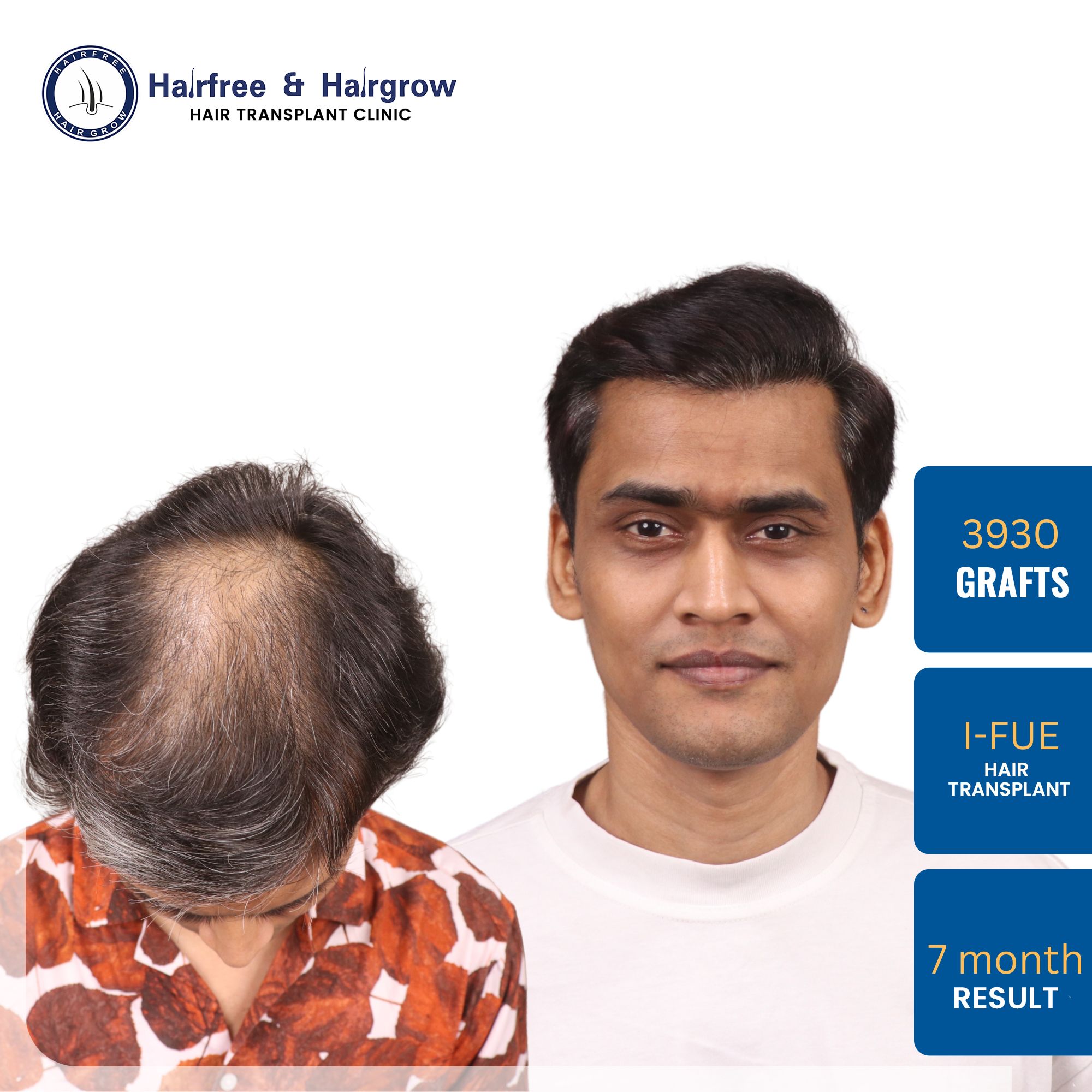
Hair Loss Condition Before Hair Transplant
Before undergoing the procedure, Dev Patil was experiencing progressive hair thinning across the frontal, mid-scalp, and crown regions. The diffuse hair loss pattern made the scalp highly visible, especially under bright lighting and from top-down views.
The advanced thinning was negatively affecting facial aesthetics and making the patient appear older than his actual age.
Main Hair Loss Concerns
- Advanced scalp baldness
- Severe top scalp thinning
- Visible scalp exposure
- Weak frontal density
- Reduced hair volume
- Difficulty styling hair
- Poor facial framing
- Prematurely aged appearance
- Loss of confidence in social settings
The patient was looking for a permanent hair restoration solution capable of delivering natural density and long-term results.
Detailed Hair Transplant Planning and Scalp Analysis
Successful hair transplant results depend heavily on proper planning rather than simply implanting a large number of grafts. In this case, a comprehensive scalp analysis and donor evaluation were performed before designing the treatment plan.
The focus was not only on restoring existing bald areas but also on maintaining long-term scalp balance and donor area stability.
Key Objectives of the Procedure
- Restore frontal and top scalp density
- Reduce visible baldness
- Improve overall scalp coverage
- Create natural hair direction and angulation
- Preserve donor area quality
- Achieve realistic density distribution
- Ensure natural-looking long-term outcomes
A customized implantation strategy was created to maximize cosmetic improvement while maintaining completely natural aesthetics.
Customized Natural Hairline Design
Hairline design plays one of the most important roles in achieving natural hair transplant results. An improperly designed hairline can appear artificial regardless of graft count.
For Dev Patil, the hairline was carefully designed according to the following:
- Facial proportions
- Existing native hair pattern
- Hair texture and caliber
- Age profile
- Future hair loss progression
Hairline Design Goals
- Natural frontal appearance
- Soft and feathered transition zone
- Proper facial symmetry
- Balanced density distribution
- Youthful yet mature hairline
- Natural facial framing
The final design blended naturally with the patient’s facial structure without appearing overdone or unnatural.
Advanced I-FUE Hair Transplant Technique
The procedure was performed using advanced I-FUE (Implanter Follicular Unit Extraction) technology at the Hairfree & Hairgrow Hair Transplant Clinic.
I-FUE is an advanced minimally invasive hair transplant technique that allows precise extraction and implantation of healthy follicular grafts with high survival rates and natural growth direction.
Compared to conventional methods, I-FUE offers better implantation precision, improved graft handling, and faster recovery.
Benefits of I-FUE Hair Transplant
- Minimally invasive procedure
- Faster healing process
- No major linear scarring
- High graft survival rate
- Natural density creation
- Better implantation control
- Reduced trauma to grafts
- Long-lasting natural-looking results
Each graft was strategically implanted to ensure proper hair angulation, density balance, and natural growth patterns.
Strategic Implantation of 3930 Grafts
A total of 3930 grafts were implanted across the frontal, mid-scalp, and crown regions to improve density and restore balanced scalp coverage.
The implantation process focused on creating maximum visible density while maintaining a completely natural appearance.
Implantation Focus Areas
Frontal Hairline Restoration
The frontal zone received dense and carefully angled implantation to recreate a natural hairline and improve facial framing.
Mid-scalp density enhancement
Diffuse thinning in the mid-scalp area was addressed using balanced graft distribution for fuller appearance and continuity.
Crown and Top Scalp Coverage
Strategic graft placement helped reduce visible scalp exposure and improve overall scalp density from top-angle views.
Implantation Highlights
- Dense frontal packing
- Natural graft angulation
- Balanced density transition
- Soft and realistic hairline
- Improved scalp coverage under lighting
- Long-term density planning
- Natural blending with existing hair
The procedure focused on delivering high cosmetic impact without compromising natural aesthetics.
7-Month Hair Transplant Result
At 7 months after the procedure, Dev Patil achieved major improvement in density, scalp coverage, and overall appearance.
The transplanted grafts demonstrated healthy survival and strong visible growth progression, creating a fuller and more youthful look.
Before Hair Transplant
- Advanced scalp baldness
- Large visible thinning area
- Significant scalp exposure
- Poor frontal density
- Weak facial framing
- Older appearance
After 7 Months
- Fuller scalp appearance
- Strong visible density improvement
- Reduced scalp visibility
- Natural-looking hairline restoration
- Better facial aesthetics
- Improved hairstyle flexibility
- More youthful appearance
- Enhanced self-confidence
The current result already reflects excellent early-stage density development, with further maturation expected over the coming months.
Hair Growth Timeline After Hair Transplant
0–2 Months: Recovery and Shedding Phase
Temporary shedding of transplanted hair occurs during the early recovery phase. This is completely normal and expected after hair transplant surgery.
3–4 Months: Initial Hair Growth Phase
Early visible growth begins in the transplanted regions with gradual improvement in frontal density and scalp coverage.
5–7 Months: Rapid Density Improvement
This phase typically shows accelerated growth and visible thickening. The patient begins experiencing noticeable cosmetic transformation.
8–12 Months: Final Mature Result
Hair texture, density, and overall appearance continue improving, resulting in mature and natural-looking final outcomes.
Key Achievements of This Hair Transplant Case
- Natural-looking density restoration
- Significant reduction in scalp visibility
- Strong graft survival and healthy growth
- Improved frontal and top scalp coverage
- Youthful facial enhancement
- Better hairstyle flexibility
- Enhanced confidence and appearance
- Excellent transformation within 7 months
Why This Hair Transplant Result Looks Natural
Natural hair transplant outcomes are achieved through a combination of medical expertise, artistic hairline design, and strategic implantation techniques.
This case stands out because of the following:
- Proper graft distribution planning
- Age-appropriate hairline design
- Natural density transition
- Correct graft angulation
- Balanced frontal packing
- Strategic top-scalp coverage
- Advanced I-FUE implantation precision
The result appears natural both under direct lighting and from multiple viewing angles.
Conclusion
This successful hair transplant transformation of Dev Patil at Hairfree & Hairgrow Hair Transplant Clinic demonstrates how advanced I-FUE hair transplant techniques can effectively restore density, improve scalp coverage, and rebuild confidence in patients experiencing advanced hair thinning and baldness.
At just 7 months post-procedure, the patient achieved:
- Strong visible hair growth
- Fuller scalp density
- Reduced bald appearance
- Natural hairline restoration
- Improved facial aesthetics
- Better styling flexibility
- Enhanced confidence
This case highlights the importance of proper planning, advanced implantation techniques, and natural hairline design in achieving long-lasting and realistic hair transplant results.