Case Overview
-
Patient: Harpreet Singh
-
Procedure: I-FUE Hair Transplant
-
Documented Graft Count: 3,312 Grafts
-
Follow-Up Period: 1.1 Years
-
Clinic: Hairfree & Hairgrow Hair Transplant Clinic
-
Location: India
Patient Background
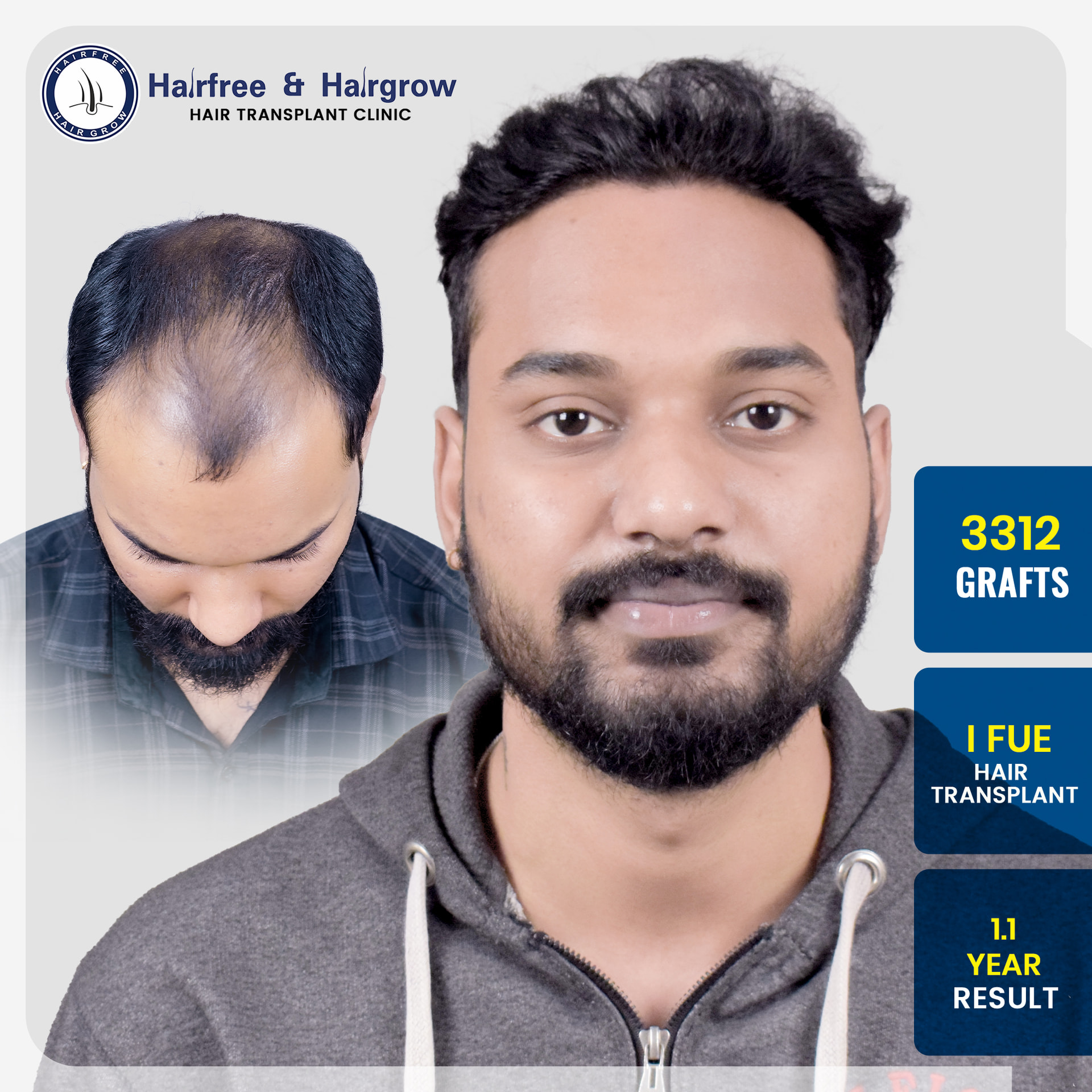
Harpreet Singh underwent an I-FUE (Individual Follicular Unit Extraction) hair transplant involving 3,312 documented grafts at Hairfree & Hairgrow Hair Transplant Clinic.
The supplied before-and-after creative presents his appearance before treatment and at the 1.1-year follow-up.
The pre-treatment photograph shows visible hair thinning across the frontal and mid-scalp regions, while the follow-up photograph provides a visual reference for assessing his hair appearance after the procedure.
The documented photographs allow readers to compare changes in the appearance of the frontal hairline and overall visible hair coverage.
This case study documents a 3,312-graft I-FUE hair transplant and a 1.1-year photographic follow-up. Individual outcomes vary depending on donor hair characteristics, graft placement, healing, existing hair loss, and other patient-specific factors.
Understanding Harpreet Singh’s 1.1-Year Hair Transplant Result
Hair transplantation is a surgical hair restoration procedure that involves transferring follicular units from a suitable donor area to areas affected by hair loss.
In Harpreet Singh’s case, 3,312 grafts were documented during his I-FUE hair transplant.
The supplied before-and-after photographs provide an opportunity to visually assess his appearance at different stages of the treatment journey.
Several factors are important when evaluating a hair transplant result:
-
Frontal Hairline Appearance: The appearance and design of the frontal hairline following transplantation.
-
Frontal Hair Coverage: The visible distribution of hair across the frontal scalp.
-
Mid-Scalp Coverage: The appearance of hair distribution in the middle region of the scalp.
-
Hair Characteristics: Hair caliber, texture, and natural growth direction.
-
Donor-Area Condition: The appearance and healing of the donor area following follicular unit extraction.
-
Hair Growth Progression: Changes in the appearance of transplanted hair during the recovery period.
-
Long-Term Hair Loss Management: Monitoring existing, non-transplanted hair that may continue to experience hair loss.
At approximately 1.1 years after transplantation, the photographic appearance can be reviewed alongside a clinical examination. Objective conclusions about graft survival and hair density require appropriate medical assessment.
What Is an I-FUE Hair Transplant?
I-FUE (Individual Follicular Unit Extraction) is the procedure designation used in this patient’s case.
FUE, or Follicular Unit Extraction, is a hair transplantation technique in which individual follicular units are extracted from a suitable donor area and implanted into selected recipient areas.
The specific technical meaning of the I-FUE designation and any differences from conventional FUE should be confirmed with the treating clinic.
Hair transplant planning generally considers:
-
The patient’s hair-loss pattern and severity.
-
Donor-area density and available graft capacity.
-
Recipient-area coverage requirements.
-
Natural hairline design and facial proportions.
-
Hair characteristics and expected growth direction.
-
Future hair loss and long-term restoration planning.
The appropriate graft count depends on individual medical assessment. A higher graft count does not automatically guarantee greater density or a better hair transplant result.
Choosing a Hair Transplant Clinic in India
Choosing the right hair transplant clinic is an important decision for individuals considering surgical hair restoration.
Before selecting a hair transplant hospital or clinic, prospective patients should evaluate several factors.
1. Qualified Medical Professionals
Understand who evaluates the patient, plans the procedure, and performs the relevant clinical steps. Verify the qualifications and responsibilities of the medical professionals involved.
2. Individualized Graft Planning
Graft requirements should be determined according to donor hair availability, recipient-area requirements, hair-loss progression, and individual treatment expectations.
3. Transparent Treatment Information
Patients should receive clear information about the proposed hair transplant technique, estimated graft count, recovery timeline, possible complications, and postoperative care.
4. Authentic Hair Transplant Before-and-After Results
Review genuine patient photographs with appropriate consent and clearly documented follow-up periods. Consistent lighting, camera angles, hairstyle, and photographic conditions help make comparisons more informative.
5. Postoperative Care and Follow-Up
A structured follow-up process helps monitor healing, document hair growth progression, and address postoperative concerns.
Hairfree & Hairgrow Hair Transplant Clinic documents patient treatment journeys and photographic follow-ups to help prospective patients understand different hair restoration experiences.
Why Is Hair Transplant Follow-Up Important?
Follow-up appointments are an important part of postoperative care following hair transplantation.
Depending on the patient’s treatment plan, follow-up assessments may include:
-
Reviewing donor-area and recipient-area healing.
-
Monitoring recovery and possible complications.
-
Documenting changes in hair growth and coverage.
-
Assessing the appearance of the transplanted hairline.
-
Reviewing postoperative care requirements.
-
Discussing ongoing hair-loss management.
-
Evaluating whether additional treatment may be appropriate.
For Harpreet Singh, the available case documentation includes a photographic follow-up approximately 1.1 years after his 3,312-graft I-FUE hair transplant.
Conclusion
Harpreet Singh’s case documents a 3,312-graft I-FUE hair transplant with a 1.1-year photographic follow-up at Hairfree & Hairgrow Hair Transplant Clinic.
The supplied photographs provide a visual reference for comparing his pre-treatment appearance with the documented follow-up.
For individuals researching I-FUE hair transplantation in India, this case offers an example of a documented patient treatment journey.
A personal consultation with a qualified medical professional can help determine suitable hair restoration options based on individual hair-loss patterns, donor capacity, medical history, and treatment expectations.
Medical Disclaimer
This case study is intended for educational and informational purposes only and does not replace individual medical advice. Hair growth, healing, density, coverage, and long-term outcomes vary between individuals. No specific result is guaranteed.
Patients should discuss the potential benefits, risks, limitations, alternatives, and recovery requirements with a qualified medical professional before undergoing hair transplantation.
Patient photographs and identifiable information should only be published with appropriate consent and in accordance with applicable privacy, professional, and medical advertising requirements.