Case Overview
-
Patient: Mahesh Gupta
-
Procedure: BIG FUE Hair Transplant
-
Documented Graft Count: 3,000 Grafts
-
Follow-Up Period: 1.3 Years
-
Clinic: Hairfree & Hairgrow Hair Transplant Clinic
-
Location: India
Patient Background
Mahesh Gupta underwent a BIG FUE hair transplant involving 3,000 documented grafts at Hairfree & Hairgrow Hair Transplant Clinic.
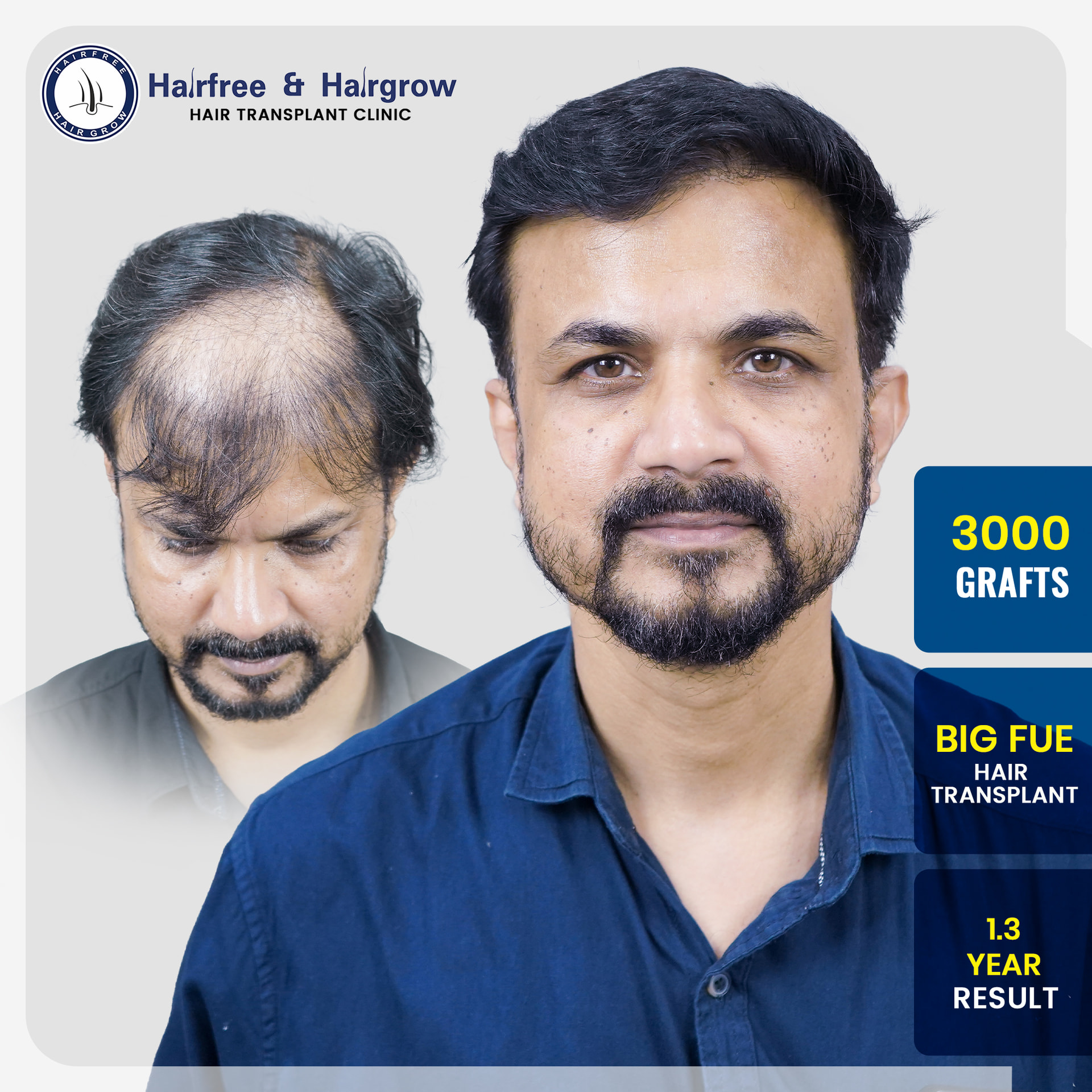
The supplied before-and-after creative presents his appearance before treatment and at the 1.3-year follow-up.
The pre-treatment photograph shows noticeable hair thinning across the frontal scalp and mid-scalp regions, with visible scalp exposure and reduced hair coverage. The post-treatment photograph, taken approximately 1.3 years after the procedure, shows improved visible hair coverage across the frontal region, a more defined hairline, and a fuller overall hair appearance.
The photographs provide a visual comparison of Mahesh Gupta’s hair restoration journey following his 3,000-graft BIG FUE hair transplant.
This case study documents the procedure and the photographic follow-up at 1.3 years. Individual hair transplant outcomes vary depending on donor hair characteristics, graft placement, healing, hair caliber, and other patient-specific factors.
Understanding Mahesh Gupta’s 1.3-Year Hair Transplant Result
Hair transplantation is a surgical hair restoration procedure that involves transferring follicular units from a suitable donor area to areas affected by hair loss.
In Mahesh Gupta’s case, 3,000 grafts were documented during his BIG FUE hair transplant.
The supplied before-and-after photographs provide an opportunity to assess the visible changes in his hair appearance following the procedure.
Key aspects of his photographic result include:
-
Frontal Hairline Appearance: The post-treatment photograph shows a more defined frontal hairline compared with the pre-treatment appearance.
-
Frontal Hair Coverage: Improved visible hair coverage across the frontal scalp can be observed in the follow-up photograph.
-
Mid-Scalp Appearance: The post-treatment image presents a fuller overall hair appearance compared with the visible thinning before treatment.
-
Hair Density Appearance: The transplanted region appears to have improved visible coverage at the documented follow-up.
-
Natural-Looking Hairline: The frontal hairline appears more defined, contributing to the overall hair restoration appearance.
-
Long-Term Hair Restoration: Continued monitoring helps assess the stability of transplanted hair and the progression of existing hair loss.
The photographic comparison represents an individual patient outcome and should not be considered a guaranteed result for other individuals.
What Can You Expect 1 Year After a Hair Transplant?
The one-year mark is an important milestone in the hair transplant recovery journey. By this stage, many patients have experienced substantial development of transplanted hair, although the extent of growth and cosmetic improvement varies.
In Mahesh Gupta’s case, the supplied photograph documents his appearance approximately 1.3 years after undergoing a 3,000-graft BIG FUE hair transplant.
Hair transplant outcomes are influenced by several factors, including:
-
Donor hair quality and density.
-
Graft survival and placement.
-
Individual hair growth cycles.
-
Hair caliber and texture.
-
Healing and postoperative care.
-
Progression of existing non-transplanted hair loss.
A follow-up assessment by the treating medical professional can help evaluate hair growth, coverage, and long-term restoration progress.
What Is a BIG FUE Hair Transplant?
FUE (Follicular Unit Extraction) is a hair transplantation technique in which individual follicular units are extracted from a suitable donor area and implanted into selected recipient areas.
BIG FUE is the procedure designation used in Mahesh Gupta’s case. The specific technical meaning and procedural differences associated with this designation should be confirmed with the treating clinic.
Hair transplant planning generally considers:
-
The patient’s hair-loss pattern and severity.
-
Donor-area density and available graft capacity.
-
Recipient-area coverage requirements.
-
Natural hairline design and facial proportions.
-
Hair characteristics and expected growth direction.
-
Future hair loss and long-term restoration planning.
The appropriate graft count depends on individual medical assessment. A 3,000-graft procedure may be suitable for some patients, but graft requirements differ according to the extent of hair loss and donor availability.
Choosing a Hair Transplant Clinic in India
Choosing an appropriate hair transplant clinic Pune is an important decision for individuals considering surgical hair restoration.
Before selecting a hair transplant hospital or clinic, prospective patients should evaluate the following factors.
1. Qualified Medical Professionals
Understand who evaluates the patient, plans the procedure, and performs the relevant clinical steps. Verify the qualifications and responsibilities of the medical professionals involved.
2. Individualized Graft Planning
Graft requirements should be determined according to donor hair availability, recipient-area requirements, hair-loss progression, and individual treatment expectations.
3. Transparent Treatment Information
Patients should receive clear information about the proposed hair transplant technique, estimated graft count, recovery timeline, potential complications, and postoperative care.
4. Authentic Hair Transplant Before-and-After Results
Review genuine patient photographs with appropriate consent and clearly documented follow-up periods. Consistent lighting, camera angles, hairstyle, and photographic conditions help make comparisons more informative.
5. Postoperative Care and Follow-Up
A structured follow-up process helps monitor healing, document hair growth progression, and address postoperative concerns.
Hairfree & Hairgrow Hair Transplant Clinic documents patient treatment journeys and photographic follow-ups to help prospective patients understand different hair restoration experiences.
Why Is Hair Transplant Follow-Up Important?
Follow-up appointments are an important part of postoperative care following hair transplantation.
Depending on the patient’s treatment plan, follow-up assessments may include:
-
Reviewing donor-area and recipient-area healing.
-
Monitoring recovery and possible complications.
-
Documenting changes in hair growth and coverage.
-
Assessing the appearance of the transplanted hairline.
-
Reviewing postoperative care requirements.
-
Discussing ongoing hair-loss management.
-
Evaluating whether additional treatment may be appropriate.
For Mahesh Gupta, the available case documentation includes a photographic follow-up approximately 1.3 years after his 3,000-graft BIG FUE hair transplant.
This follow-up provides a reference for assessing his hair restoration progress beyond the first year.
Conclusion
Mahesh Gupta’s case documents a 3,000-graft BIG FUE hair transplant with a 1.3-year photographic follow-up at Hairfree & Hairgrow Hair Transplant Clinic.
The supplied before-and-after photographs show a visible difference in his frontal hairline appearance and overall hair coverage following the procedure.
For individuals researching BIG FUE hair transplantation in India, this case provides an example of a documented patient hair restoration journey.
A personal consultation with a qualified medical professional can help determine suitable hair restoration options based on individual hair-loss patterns, donor capacity, medical history, and treatment expectations.
Medical Disclaimer
This case study is intended for educational and informational purposes only and does not replace individual medical advice. Hair growth, healing, density, coverage, and long-term outcomes vary between individuals. Photographic results represent an individual patient experience and do not guarantee similar outcomes for other patients.
Patients should discuss the potential benefits, risks, limitations, alternatives, and recovery requirements with a qualified medical professional before undergoing hair transplantation.
Patient photographs and identifiable information should only be published with appropriate consent and in accordance with applicable privacy, professional, and medical advertising requirements.