Case Overview
-
Patient: Vivek Shukla
-
Procedure: I-FUE Hair Transplant
-
Documented Graft Count: 400 grafts
-
Follow-Up Period: 1.2 years
-
Location: Pune, Maharashtra, India
Clinical Background
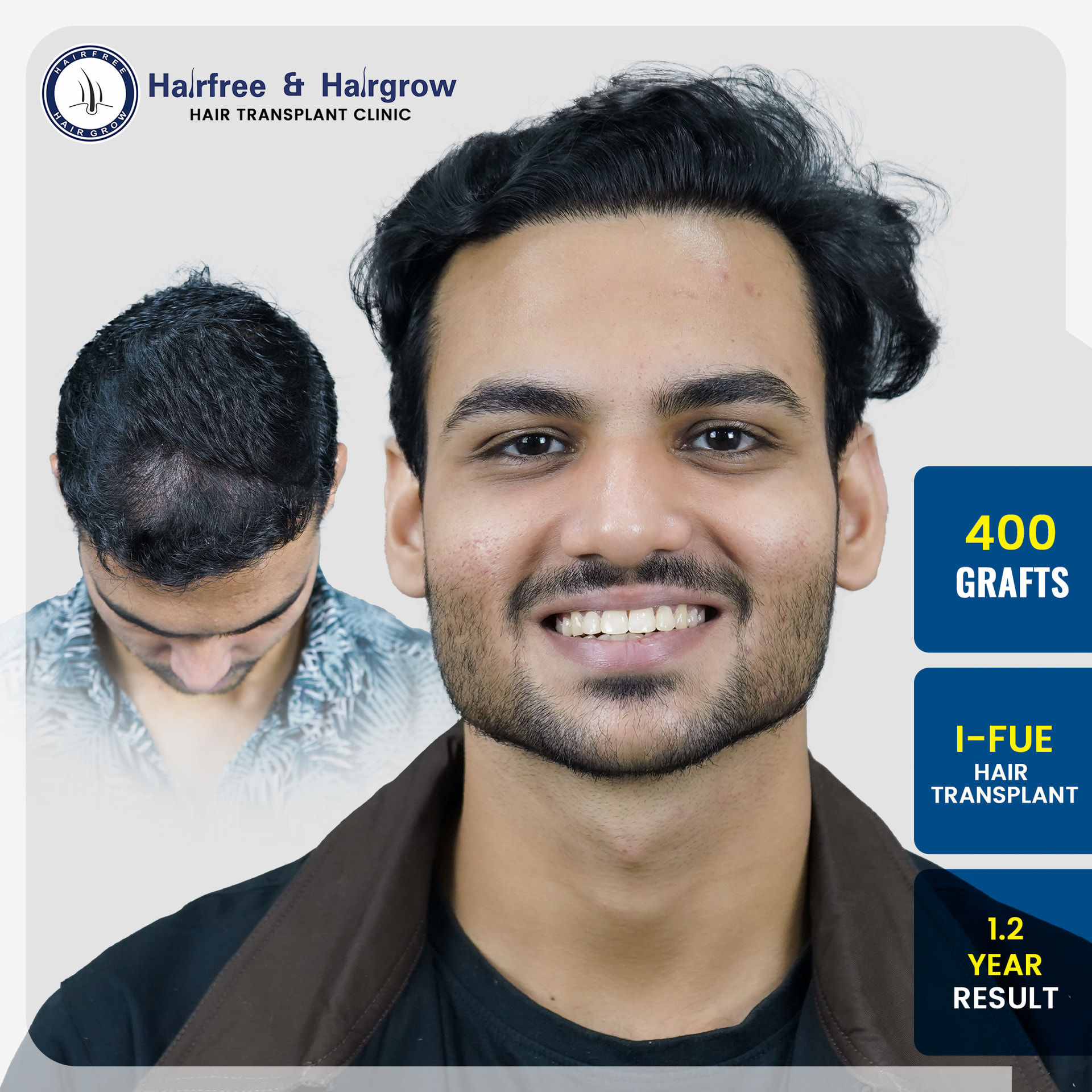
This case study documents the hair transplant procedure and follow-up of Vivek Shukla, who underwent an I-FUE hair transplant involving 400 grafts at Hairfree & Hairgrow Hair Transplant Clinic in Pune, Maharashtra, India.
The supplied before-and-after image presents the patient’s scalp before treatment and his appearance at the 1.2-year follow-up. The photographs provide a visual reference for comparing the documented stages of his hair restoration journey.
The treatment involved a relatively limited number of grafts. However, the specific treatment area, original hair-loss pattern, and clinical rationale for selecting 400 grafts should be confirmed from the patient’s medical records.
Understanding the 1.2-Year Hair Transplant Result
Hair transplantation involves relocating follicular units from a suitable donor area to selected areas of the scalp. Following transplantation, hair growth and the appearance of the treated area change over time, with outcomes varying between individuals.
The 1.2-year follow-up photograph documents the patient’s appearance approximately 14–15 months after treatment. The image can help illustrate the visible result at that stage, but it cannot independently establish graft survival, final hair density, or long-term treatment success.
For meaningful before-and-after comparisons, photographs should ideally use consistent lighting, camera angles, hair length, and positioning. A complete assessment also considers clinical examination findings and the patient’s treatment history.
What Is an I-FUE Hair Transplant?
Follicular Unit Extraction (FUE) is a hair transplantation technique in which individual follicular units are extracted from a suitable donor area and implanted into selected recipient areas.
I-FUE is the procedure designation used in this case. Any additional technical meaning associated with this term should be confirmed by the treating clinical team.
Treatment planning may consider:
-
The location and extent of hair loss.
-
Donor-area density and follicular availability.
-
Hair characteristics and the recipient area’s requirements.
-
Hairline design and graft distribution.
-
Recovery expectations, potential complications, and future hair-loss progression.
The appropriate technique and graft allocation depend on an individual’s clinical assessment.
Why Can a Hair Transplant Involve Only 400 Grafts?
Not every hair transplant requires thousands of grafts. A smaller graft count may be considered when the treatment objective involves a limited area, such as a localized region requiring additional coverage or refinement.
However, the reason for using 400 grafts in Vivek Shukla’s case should not be assumed without reviewing the clinical treatment plan.
Graft allocation depends on the size of the recipient area, existing hair distribution, donor characteristics, desired coverage, and the treating clinician’s assessment. The number of grafts alone does not determine the final cosmetic appearance or establish treatment effectiveness.
Clinical Documentation and Follow-Up
A structured hair transplant follow-up process may include:
-
Reviewing postoperative healing and any complications.
-
Assessing the donor and recipient areas.
-
Documenting hair growth and distribution at scheduled visits.
-
Reviewing ongoing hair-loss management where clinically appropriate.
-
Discussing patient concerns and any further treatment options.
Clinical findings should be based on appropriate examinations and documented records rather than photographs alone.
Conclusion
Vivek Shukla’s case documents a 400-graft I-FUE hair transplant at Hairfree & Hairgrow Hair Transplant Clinic in Pune, Maharashtra, with a photographic follow-up at 1.2 years.
This case illustrates that hair restoration treatment can involve different graft counts depending on individual requirements. Appropriate treatment planning, realistic expectations, consistent photographic documentation, and continued clinical follow-up are important aspects of hair restoration care.
The documented graft count and follow-up period do not guarantee a particular outcome for this or any other patient.
Medical Disclaimer
This case study is provided for educational purposes and describes an individual hair transplant procedure and follow-up period. Hair growth, density, coverage, healing, and longer-term outcomes vary between individuals. No specific result is guaranteed. A qualified medical professional should assess treatment suitability and explain the potential benefits, risks, limitations, recovery process, and available alternatives before treatment.
Publication of identifiable patient photographs and clinical details should be supported by appropriate consent and comply with applicable privacy, professional, and advertising requirements.